
Most advice on how to create content strategy starts in the wrong place. It starts with content ideas, posting frequency, or a nice-looking calendar. That's why so many strategies die in a Google Doc.
A working content strategy isn't a document. It's an operating system. Each topic needs a real UK demand signal, a clear search intent, a repeatable page template, a publish date, and a review point in Search Console. If any one of those is missing, the plan usually turns into random publishing.
I've spent ten years fixing content programmes that looked busy but weren't built to rank, convert, or compound. The pattern is usually the same: too many topics, weak briefs, no link between keyword and page type, and no monthly review loop. If you want to know how to create content strategy that holds up, build the system first, then fill it with topics.
Table of Contents
- Why Most Content Strategies Fail Before They Start
- Audience and Keyword Research That Drives the Plan
- Mapping Keywords to Intent and Templates
- Building the Editorial Calendar
- Site Structure and Internal Linking
- Measurement and Iteration
- A Simple Checklist to Start Next Week
Why Most Content Strategies Fail Before They Start
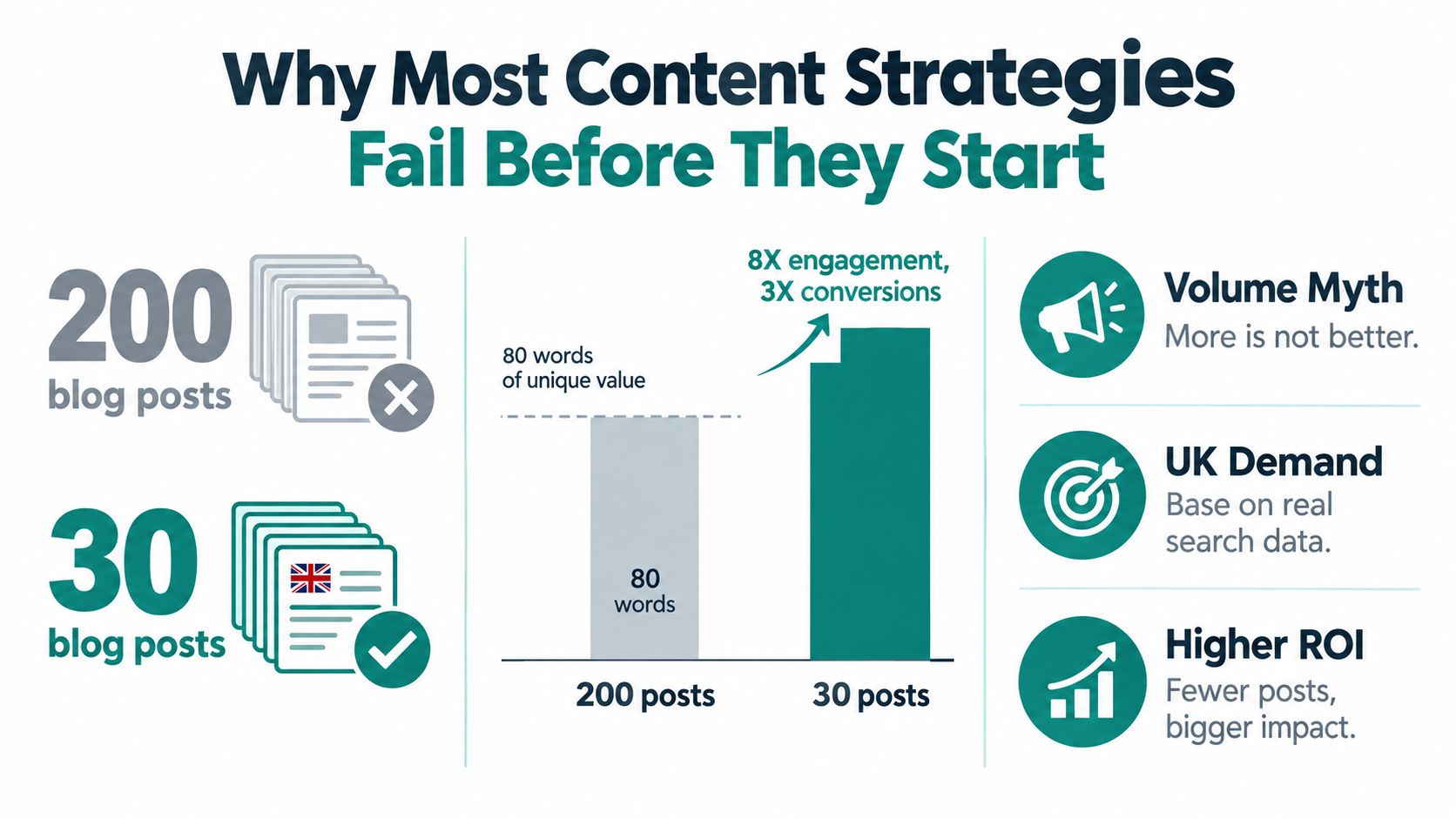
The failure usually happens before a word is written. Teams approve a content plan that looks organised, then realise six weeks later that half the topics had no clear demand, two were mapped to the wrong page type, and nobody agreed how success would be measured.
That approach made more sense when one dominant platform controlled discovery. It makes less sense now. Ofcom's Online Nation 2024 report shows that nine in ten UK online adults used at least one of the ten highest-reaching search services in May 2024, while Google reached 83% of UK online adults, down from 86% a year earlier. Discovery is still search-led, but it is less concentrated than many editorial plans assume. A strategy built as a list of blog ideas cannot handle that. An operating system can.
The discipline problem is older, and still relevant. CMI's 2014 UK research found that only 40% of UK marketers had a documented content marketing strategy, 38% lacked clarity on what success looked like, and 49% included a measurement plan. The figures are dated, but the pattern has not disappeared. I still inherit programmes where the team can tell me how many articles went live, but not which URLs were meant to rank for which terms, or what should happen after publication.
The four failure patterns I keep seeing
Across ten years of client work, the same faults show up again and again:
- Topics get approved without live demand checks, so the plan reflects internal enthusiasm more than UK search behaviour.
- Writers are briefed before anyone studies the SERP, so an article is produced where a comparison page, service page, or category page should have existed.
- The calendar is treated as final, which means no one updates priorities after Search Console shows impressions on the wrong queries or weak CTR on promising terms.
- Measurement sits in a separate report, so the original brief, target keyword, template choice, and outcome are never tied back to the same URL.
One missing field is enough to break the system. If a topic has no demand signal, no page template, or no review date, it usually turns into content for content's sake.
What a working strategy looks like
A working strategy is operational, not decorative. For each page, I want one primary keyword set, one intent, one template, one owner, one publish slot, and one review point 30 to 45 days after indexing. I usually track that in Airtable or Sheets, validate demand in Ahrefs, and use Google Search Console to decide what gets improved, merged, or cut.
That sounds basic because it is. The trade-off is that this method produces fewer ideas up front and more useful pages over time. Clients often resist that at first. They want a 50-topic calendar. What tends to perform better is a tighter set of 12 to 20 pages with clean intent mapping, internal link support, and a monthly review loop.
For a broader take on this operating model, read this proven content strategy for marketers.
When teams skip that structure, they publish assets. When they use it, they build a system that can respond to real demand, page by page, month by month.
Audience and Keyword Research That Drives the Plan
Audience research is where the plan either becomes useful or starts drifting. I begin with a single line that names the buyer, the situation, and the decision in plain English. For example: “UK operations managers at small logistics firms need a faster way to compare delivery software before they book a demo.” If that sentence is vague, the keyword list will be vague as well.
I then check whether the business uses the same language as its customers. In practice, that means reading sales call notes, support tickets, chatbot transcripts, CRM fields, and closed-won reasons. I have seen too many teams optimise around internal category terms that nobody searches for. If customers say “delivery management software” and the company insists on “last-mile orchestration platform”, the customer phrasing wins.
Build the seed list from places that already contain buyer language
The starting stack is simple. CRM exports show commercial phrasing. Ahrefs Content Gap shows where competitors already collect visibility. AnswerThePublic adds the question layer that briefs often miss.
For smaller sites, a practical companion resource is this guide to SEO for small business sites, especially if you need a lighter process that still produces usable topics.
I cut the first export hard. Relevance comes first, then evidence of demand, then the site's realistic chance of earning traffic in the UK. The framework I use here is to tie content choices to search demand and measurable outcomes, then review them monthly in GA4 and Search Console. That keeps the strategy tied to pages that can be published, measured, and improved, rather than a research document nobody touches again.
This is the trade-off clients push back on. A wider list feels productive. A tighter list performs better.
Turn raw keywords into a publishable shortlist
From there, I expand with Keyword Surfer and Keywords Everywhere, then sort terms by modifier patterns such as “how”, “what”, “best”, “vs”, “software”, and “pricing”. I also tag each keyword by audience segment and commercial value. A query like “best delivery management software” does not belong in the same bucket as “what is route optimisation”, even if both sit in the same topic cluster.
The output I want is a shortlist with publishing logic attached to it.
- Seed source noted: CRM, Ahrefs Content Gap, AnswerThePublic, or direct customer language
- Intent guess added: Informational, commercial, transactional, or navigational
- Audience note included: Who the page is for and what decision they are trying to make
- Ranking reality checked: Whether the site has enough topical depth and authority to compete
At this stage I usually move the working list into a sheet or into content marketing planning inside Sibley Digital's content-marketing work, because the page brief, review date, and target query set matter more than the export itself.
Good research cuts false starts. Weak research fills the calendar with pages that never had a ranking case.
A shortlist of 30 to 50 terms is usually enough for the next publishing cycle. Beyond that, teams stop choosing and start collecting.
Mapping Keywords to Intent and Templates
Keyword research on its own isn't strategy. The work starts when you classify each term by what Google is already rewarding in the UK top results.
I don't guess intent from the phrase alone. I open the query in an incognito browser, check the top-ranking pages, and log the dominant format. If the top results are mostly definitions and step-by-step guides, I'm not going to brief a commercial landing page and expect it to rank.
Use the live SERP as the classifier
A practical UK SEO rule here is simple: inspect the current top results first, classify the intent, then match the page type to that intent. The Peak Digital guide on search intent and page alignment explains this clearly, and it's one of the few pieces of advice I think writers should follow every single time.
I reduce the content model to four templates:
- Explainer for definitions, concepts, and broad informational queries
- How-to for process-led searches
- Comparison for “vs”, “best”, and alternative terms
- List for rounded-up options and use-case collections
If a keyword doesn't fit one of those cleanly, I send it back to research.
The template matters more than people think
Each template needs specs. Writers work better when the page type is already defined.
| Keyword | SERP Format | Template | Word Count | Required Element |
|---|---|---|---|---|
| content strategy template | listicles and downloadable resources | List | 1,200 to 1,800 | editable framework or example structure |
| how to create content strategy | step-by-step guides | How-To | 1,800 to 2,500 | process steps and tool stack |
| seo vs content marketing | comparison pages | Comparison | 1,400 to 2,000 | side-by-side decision criteria |
| what is content strategy | definitions and explainers | Explainer | 1,000 to 1,600 | clear definition and examples |
I also specify H2 count, internal links in and out, schema type, and one first-hand element. That first-hand element might be a workflow screenshot, an annotated SERP, a decision table, or a brief excerpt. It gives the page a reason to exist beyond paraphrasing what's already ranking.
If the SERP says “guide” and your draft is a thin opinion piece, the strategy failed before the writing started.
This is also where on-page discipline begins. UK SEO guidance consistently recommends placing the target keyword in the H1, the opening section, and at least one H2, while keeping usage natural, as set out in the SEO Works on-page SEO guide. That's not a trick. It's just clean signalling.
Building the Editorial Calendar
Most editorial calendars fail because they're treated as idea parking, not production control. A proper calendar answers three things: what gets published, when it gets published, and what gets refreshed instead of replaced.
I batch by template because production gets faster when the work repeats. List pages go in one batch, comparisons in another, and process-led how-tos in another. Writers stop context-switching, editors know what they're checking for, and internal linking becomes easier to plan.
A calendar needs lead times and refresh slots
I leave a two-week gap between brief sign-off and publish. That gives enough room for drafting, editing, adding first-hand material, and basic QA. If you're publishing the day after the brief is approved, the brief is probably too vague or the quality bar is too low.
I also reserve one fixed slot each month for refresh work. That slot is for underperforming pages surfaced through Search Console, not for “nice to have” edits.
A simple setup in a shared sheet or Notion database works well. If you prefer a cleaner visual planning layer, a visual workspace journal can help when you're mapping topic waves and dependencies before they go into the production tracker.
What goes into the calendar
I keep these columns visible at all times:
- Target keyword and the assigned page
- Template and search intent
- Writer and editor
- Due date and publish date
- Target word count and primary CTA
- Brief link so the URL can always be traced back to the original decision
Here's the sequencing rule that saves the most pain: publish in pillar-plus-cluster waves. If the cluster articles go live before the hub exists, internal links get bolted on later and usually stay weak.
For a B2B SaaS site targeting UK commercial terms, a four-week plan might start with one commercial pillar in week one, two supporting comparisons in week two, one implementation how-to in week three, and a refresh of the earliest supporting article in week four. That sequence builds context instead of scattering effort.
Treat the calendar as a delivery contract. Once teams start treating it as a wishlist, cadence usually slips by the third month.
Site Structure and Internal Linking
Site architecture is part of strategy, not a developer clean-up task. If the structure is weak, good pages stay isolated. They rank slower, pass less context, and are harder for users to use.
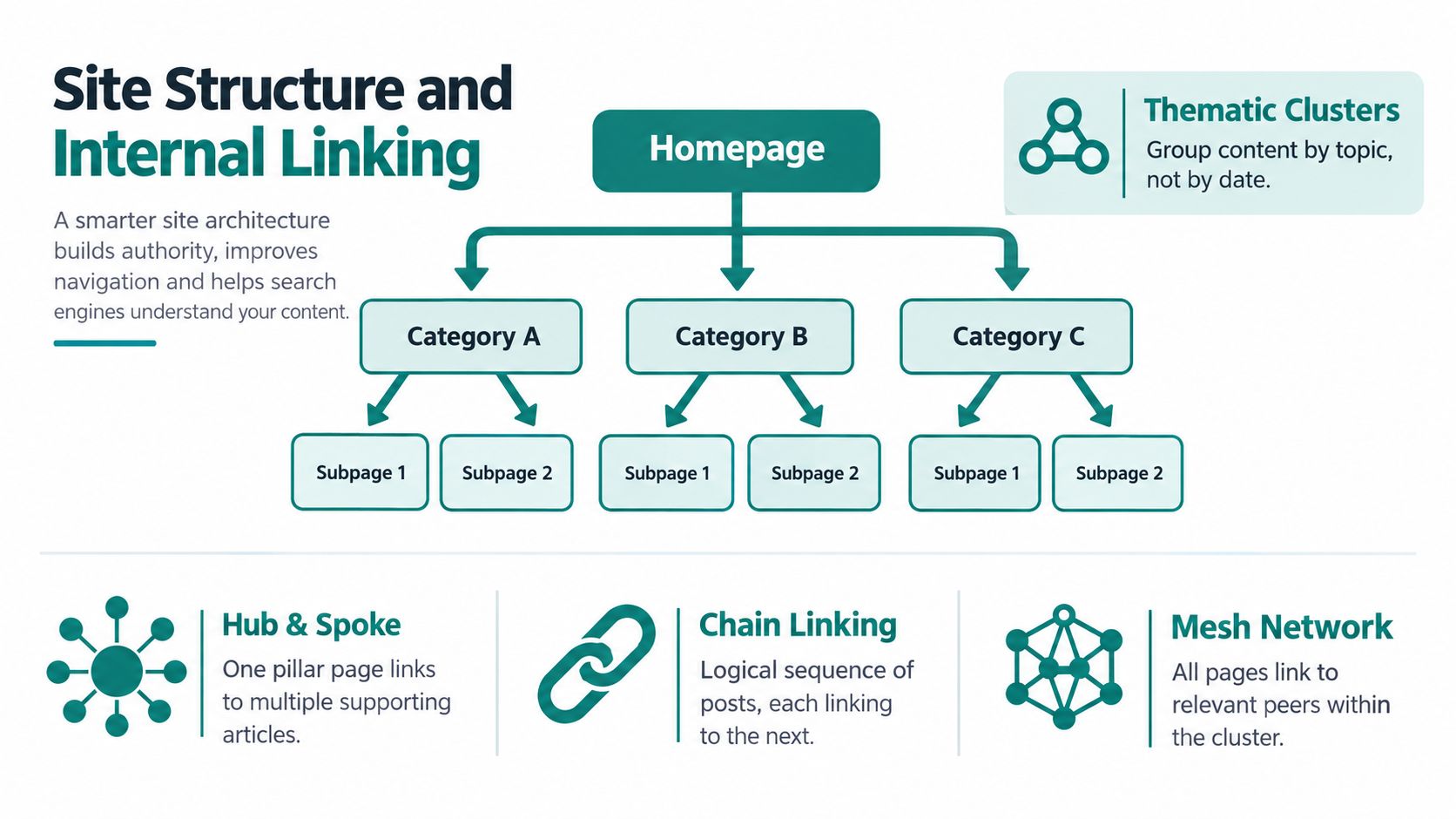
The pattern I use most is the topic cluster. One pillar page covers the main theme. Supporting pages answer narrower questions, and every supporting page links back to the pillar and across to related siblings where it helps the reader. That creates a clean topical graph rather than a dated blog archive.
Three linking patterns that work
The first is the topic cluster, which suits educational content and service-led SEO.
The second is the hub-and-spoke comparison layout. That's useful for commercial pages. A central comparison or service hub targets decision-stage terms, and supporting pages handle objections, alternatives, and narrower use cases.
The third is the resource silo. This is an index-style page that curates tools, guides, or research assets and gets rebuilt on a schedule. It works well when you need a stable destination for linkable assets.
For audits, I use Screaming Frog to find orphan pages and crawl depth issues, then Ahrefs or Semrush to spot internal link gaps. I also keep a plain spreadsheet of anchor text so teams don't over-optimise every link with the exact same phrase.
Internal links belong in the body copy, early enough to be seen and clicked. Footer widgets don't do the same job.
A more detailed process for checking weak link paths, orphaned content, and anchor misuse sits in this internal linking audit guide.
There's also a simple walkthrough worth watching if you want to see site architecture thinking laid out visually.
What changes when you restructure properly
When I restructure a messy blog, I don't start by writing more. I group existing pages into usable clusters, merge overlaps, improve contextual links, and make sure the pillar can receive and distribute relevance. In practice, that often does more than adding another few average posts.
The common mistake is burying links in sidebars, tag pages, or “related posts” widgets. Contextual in-body links above the fold carry the logic. They tell both users and search engines why the next page matters.
Measurement and Iteration
A content strategy earns its keep in the review cycle, not in the planning deck. I have seen plenty of teams publish 20 articles, admire the calendar, then skip the one thing that would have made the work pay back. Monthly decisions.
Treat the strategy like an operating system. Every page should tie back to a UK demand signal, a template, and a next action once real performance shows up in Search Console and GA4. If a page has no review date and no threshold for change, it usually sits untouched until traffic drops hard enough for someone senior to notice.
The KPI stack should stay tight. I care most about organic sessions to target pages, rankings for cluster head terms, and conversions from organic landing pages. Indexed page counts and crawl stats matter, but they support diagnosis. They should not drive editorial decisions on their own.
The dashboard I would use
I keep this simple on purpose. One 60 minute review on the first Tuesday of the month is enough for a small to mid-sized site, as long as someone turns the numbers into decisions the same day.
| Metric | Source | Decision Threshold |
|---|---|---|
| Organic sessions to target pages | GA4 | falling trend triggers page review |
| Rankings for cluster head terms | rank tracker | outside target bands triggers refresh or rework |
| Conversions from organic landing pages | GA4 | weak conversion rate triggers CTA or intent review |
| Impressions and CTR | Search Console | high impressions with low CTR triggers title rewrite |
| Crawl and index coverage | Search Console | indexing issues trigger technical check |
My rule is one page of actions, not a slide deck. Three pages to improve, three pages to merge or cut, and three topics to commission next based on fresh query data.
What the iteration loop looks like in practice
The monthly rhythm matters more than the reporting format. I pull Search Console queries by page, compare them with the target term set, then check whether the page still matches the live SERP. In UK campaigns, that catches the problem faster than staring at average position charts. Sometimes the page is slipping because competitors added comparison tables. Sometimes Google has shifted the results toward category pages, tools, or forum threads, and the old template no longer fits.
That is why I do not treat content strategy as a static plan. It is an operating system. Demand comes in through keyword research, pages get built to a clear template, then the next month's edits come from real search behaviour rather than hunches.
I also use simple on-page rules when refreshing pages. Marcomundo's keyword placement guide recommends a keyword density of 0.5% to 2%, roughly 1 to 2 keywords per 100 to 150 words, while keeping the phrase in the title tag, H1, meta description, first 100 words, and natural body copy. That is a sensible guardrail for editors who either underuse the term or force it into every paragraph.
The trigger points do not need to be fancy:
- Page not gaining traction: refresh the copy, tighten the intent match, and check whether the template fits the current SERP.
- Strong impressions, weak CTR: rewrite the title and meta description, then test a clearer promise or angle.
- Commercial page losing visibility: review SERP changes, review conversion friction, and confirm the page still deserves to rank for that term.
- Traffic up, leads flat: the content is attracting the wrong visitor or the CTA is too weak for the stage of intent.
For reporting, I prefer something repeatable over something pretty. A process like these automated SEO reports is enough if it keeps decisions visible instead of burying them in screenshots.
Good iteration is usually unglamorous. Update the title. Add the missing section. Cut the page that overlaps with a better one. Shift next month's calendar toward the query set that is already showing demand. That is how the strategy improves month by month, instead of becoming a folder full of plans no one opens again.
A Simple Checklist to Start Next Week
If you want to know how to create content strategy without overcomplicating it, do this in one working block next week and get the system in place before you write anything new.
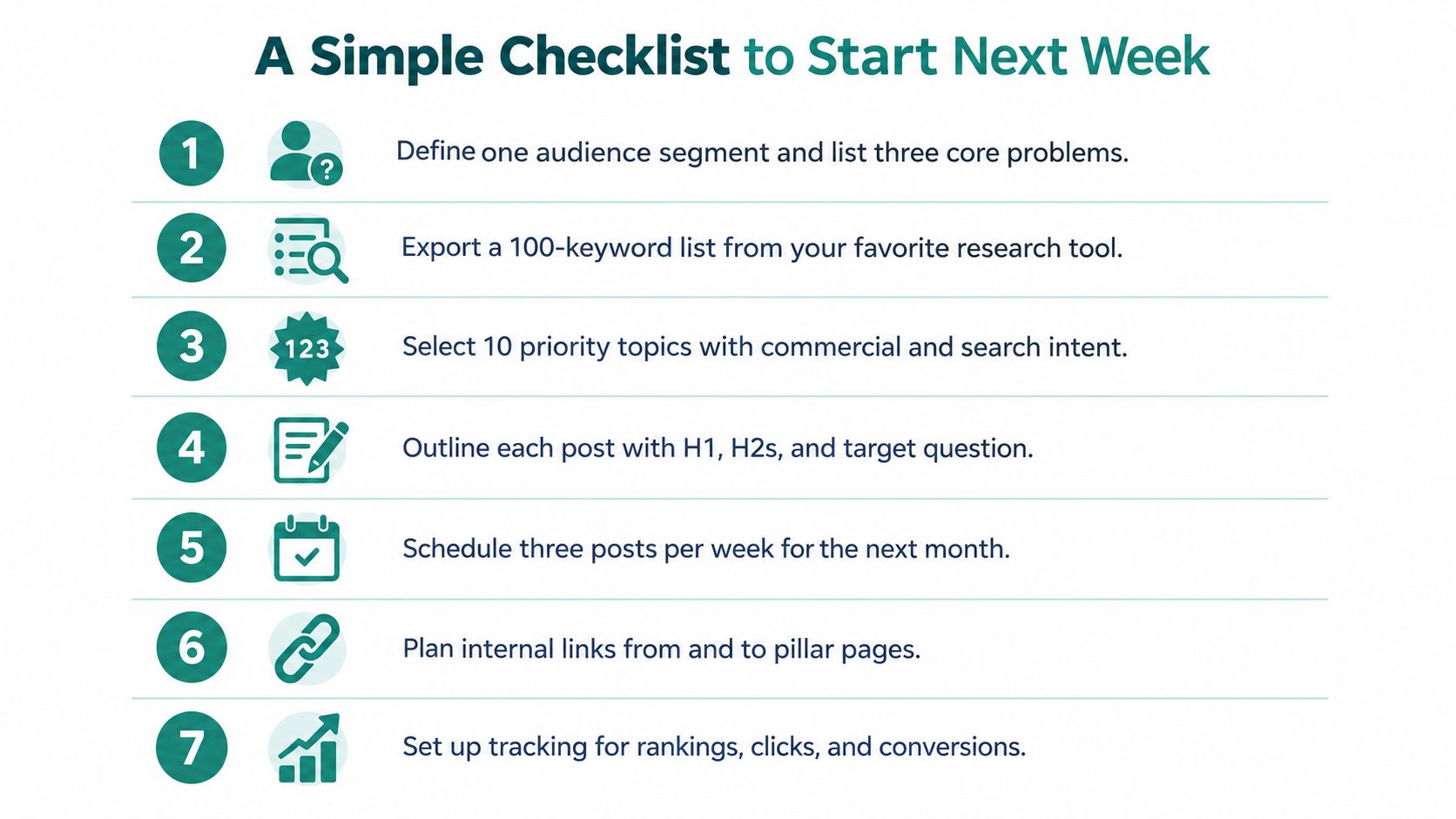
Seven steps I'd use
- Define one audience segment: spend 20 minutes writing one sentence on who they are, what job they're trying to get done, and the three problems they most want solved.
- Export a raw keyword list: use Ahrefs or Semrush for 45 minutes and pull around 100 relevant terms tied to those problems.
- Tag every term by intent: spend 30 minutes classifying them as informational, commercial, transactional, or navigational from the live SERP.
- Choose two templates: use your SERP notes to decide whether the first wave should be how-tos, comparisons, explainers, or lists.
- Draft a 30-day calendar: allow 45 minutes to assign publish dates, owners, target word counts, and one cluster hub for each theme.
- Plan internal links up front: take 20 minutes to note which new pages link to the pillar and which sibling pages they should support.
- Book the monthly review now: put a recurring Search Console and GA4 slot in the diary for 30 minutes, with two keep-or-kill decisions required each time.
What to ignore in week one
Don't waste time naming the strategy, colour-coding ten statuses, or creating a giant approval workflow. You need fewer moving parts, not more.
Independent UK data shows 65% of businesses use content marketing, 63% are satisfied with it, 25% are not satisfied, and 61% plan to grow it in 2026, according to this round-up of UK content marketing statistics. To me, that says the execution gap matters more than the theory gap.
Recent UK trend reporting also shows 55% of UK marketing teams are using predictive tools to determine content topics before they trend, while 43% want to start using interactive content and 37% want to start using user-generated content in 2026, based on Epix Media's trend report. Useful signals, but they only help if the core operating system is already in place.
Build the machine first. Then feed it better topics, better briefs, and better updates each month.
A strategy that fits your real capacity beats an ambitious content plan that never ships.
If you need help turning this into a working system, that's the sort of work Sibley Digital handles: keyword and intent research, page-level briefs, internal linking structure, and monthly reporting that stays tied to measurable outcomes. If your current content plan exists mostly in slides and scattered docs, I can help turn it into something your team can publish and improve.