
The multi-area service business has a particular search problem. The van covers ten towns, the address sits in one of them, and Google's map results are built around that address. The other nine towns have to be won in the organic results instead, and the standard tool for winning them is the local landing page, a page on your site targeting your service in their town. (If your business has genuine premises in more than one town, rather than one base and a van, the playbook is a little different, and I've covered it separately in multi-location SEO.)
The trouble is that the lazy version of this page is very cheap to produce, and the lazy version is the one Google has been ignoring, and occasionally penalising, for a decade. This post covers the difference between the two, and how to build the kind that ranks without writing ten thin copies of the same page.
Why the map pack won't carry you beyond your own town
The map pack runs on relevance, distance, and prominence, and distance is the one no amount of optimisation can argue with. I've covered how that contest works in what local SEO actually is, so the short version here is that your Google Business Profile will do a lot of work in and around the town where you're actually based, and progressively less the further out you go. You can set a service area on the profile, but it doesn't move your ranking radius anywhere near as much as people hope.
The towns beyond that radius are organic contests, fought page against page in the results underneath the map. You can't enter a contest you don't have a page for, which is the entire case for local landing pages. What matters is what you put on them.
The doorway page trap
Google's spam policies name this pattern directly. Among the listed examples of doorway abuse is having multiple pages "targeted at specific regions or cities that funnel users to one page". That is a precise description of the find-and-replace location page, one template, the town name swapped out per page, the same generic copy underneath, every version funnelling to the same contact form.
It's worth flagging that most of these pages never get penalised, because they don't need to be. They simply don't rank. Google has seen millions of them, they add nothing a searcher couldn't get from the homepage, and they get filtered or ignored rather than punished. The business owner concludes that location pages don't work, when what didn't work was publishing the same page ten times.
What separates a page that ranks from a doorway page
The difference isn't length or keyword placement. It's whether the page contains anything that could only be true of that specific area.
| Element | The doorway version | The version that ranks |
|---|---|---|
| Copy | Identical paragraphs, town name swapped | Written about how you actually serve that area |
| Proof of work | Stock photos on every page | Photos and short write-ups of real jobs in that town |
| Reviews | The same three testimonials sitewide | Reviews from customers in that area, named as such |
| Local detail | A paragraph about the town's history | Coverage, travel times, and anything that differs by area |
| Reason to exist | Ranking | Answering "do they genuinely work here?" |
The town history paragraph deserves a special mention because it's the classic tell. Nobody hires a plumber because the plumber knows when the town's cathedral was built. The question in the searcher's head is whether you really work there or whether they're about to ring someone an hour away, and every element on the page should be evidence that you do. Jobs completed there, customers quoted there, the streets or estates you know, which days you're in the area. That material can't be templated, which is exactly why it ranks.
The anatomy of a page that ranks
The evidence does the ranking, but it needs a properly built page to sit on. None of the mechanics below will rescue an empty page, and the absence of any of them can sink a full one, so get the pattern right once and reuse it.
- The URL. One clean, readable level,
/plumber-guildfordor/service-areas/guildford. No parameters, no dates, nothing a person couldn't read aloud. - The title tag. Service, then area, then business name, in that order, "Emergency Plumber in Guildford | Hart & Sons". The town belongs in the title of the page, not just somewhere in the copy.
- The H1 and opening lines. Name the service and the area in the H1, then spend the first paragraph answering the only question the visitor actually has, whether you really cover their patch. Coverage, travel time, which days you're in the area.
- NAP, handled honestly. If you have a genuine address in the area, show it and mark it up. If you don't, never invent one, state where you're based and what you cover instead. Searchers are better at smelling a fake office than most businesses expect.
- Proof of work. Two or three recent jobs in that area, your own photos rather than stock, a line or two on what each involved. This is the material that separates the page from a template, so it earns the most prominent real estate.
- Local reviews. Reviews from customers in that area, identified as such. "Great service" from an anonymous reviewer is wallpaper, "sorted our boiler in Merrow within the hour" is evidence. How to earn those at a healthy rate is covered in reviews and local rankings.
- One clear action. A phone number that's tappable and a short form, near the top and again at the end. Every additional option on the page costs you calls.
- Mobile first, genuinely. The majority of local service searches happen on a phone, often an urgent one, so the page needs to load quickly and the number needs to work with a thumb.
Where the demand data comes from
Ranking towns by demand sounds obvious until you try to do it, because local search demand hides in two places. Explicit searches, "boiler repair woking", carry volume a keyword tool will show you. Implicit searches, someone in Woking typing "boiler repair" and letting Google infer the location, are invisible in town-modified volume data, and there are usually more of them. A town showing twenty searches a month for the modified term is not a town with twenty searches of demand.
Three sources triangulate it. A keyword tool gives you the explicit volumes town by town, which are most useful relatively, if Guildford shows five times Woking's volume, that ratio holds even though the absolute numbers undercount. Search Console shows the towns already producing impressions for you, which are the contests you're closest to winning. And your own enquiry log tells you where the work you actually wanted came from, which no tool can.
Weigh those against the value of a job in each area and the proof you hold, and the shortlist mostly writes itself.
Build three properly rather than ten at once
The honest constraint on local landing pages is evidence, not writing time. You can only fill a page with real jobs and real reviews from an area if you have them, so the sensible approach is to rank your target towns by search demand, how much work you actually want from each, and how much proof you can gather today, then build the top three properly. A page backed by genuine material will outrank ten hollow ones, and each new completed job gives you material to extend the set later.
For areas where you have no evidence yet, it's better to hold off than to publish a shell. A thin page doesn't just fail on its own terms, it drags on the impression Google builds of the whole set.
Where the pages live and how they link
Location pages fail structurally as often as they fail editorially. They want to sit in a clear, crawlable hierarchy, a service-areas section linked from your main navigation or your core service page, with each area page linked properly from that hub. A row of town names buried in the footer is not internal linking, it's an ornament. On the sites I build, area pages sit one click from the service they support, link back up to it, and link sideways to neighbouring areas where that's useful to a reader.
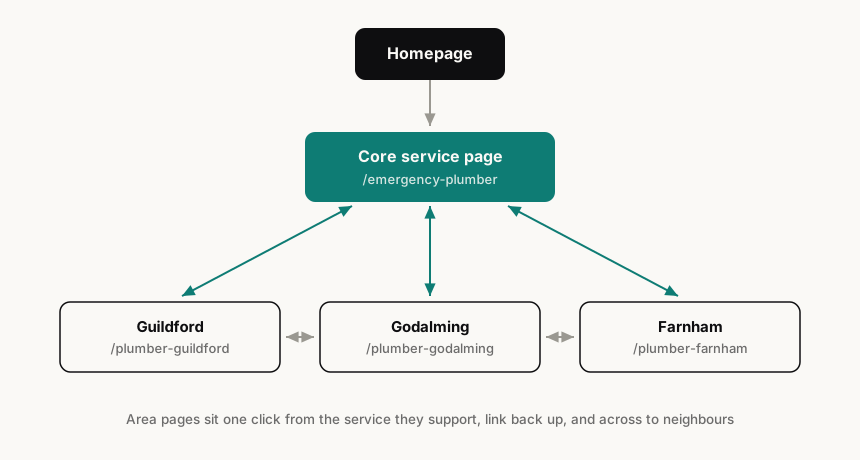
Each page should also carry the basics that any page competing in local search needs, a title tag that names the service and the area, LocalBusiness schema with your service area declared, and a crawlable route from the homepage. None of that rescues a doorway page, but its absence can sink a good one. The wider habits that support all of this are in my local SEO best practices.
The schema worth adding
Each area page should carry LocalBusiness markup, or better, the most specific type schema.org offers for what you do, Plumber, Electrician, RoofingContractor and so on. The wider question of what to mark up and what to skip applies here too. Your real address goes in the address block, wherever it happens to be, and the places you cover go in areaServed. Schema won't lift a doorway page, but it makes an honest page unambiguous to machines, and structured data is one of the details AI search tools lean on when they decide which businesses to name.
{
  "@context": "https://schema.org",
  "@type": "Plumber",
  "name": "Hart & Sons Plumbing",
  "url": "https://hartandsons.co.uk/service-areas/guildford",
  "telephone": "+44 1483 123456",
  "image": "https://hartandsons.co.uk/assets/van-guildford.jpg",
  "address": {
    "@type": "PostalAddress",
    "streetAddress": "12 Example Road",
    "addressLocality": "Woking",
    "postalCode": "GU21 1AA",
    "addressCountry": "GB"
  },
  "areaServed": [
    { "@type": "City", "name": "Guildford" },
    { "@type": "City", "name": "Godalming" },
    { "@type": "City", "name": "Farnham" }
  ],
  "sameAs": ["https://www.facebook.com/hartandsons"]
}
Two honesty rules. The address is where you're actually registered, not a virtual office rented in the target town, and areaServed lists places you genuinely cover. Marking up locations you don't serve is the structured-data version of the doorway page, and it earns the same result.
How to tell if a page is earning its keep
Judge each page in Search Console, not by searching for yourself from your own office. Filter performance by the exact URL and watch three things, impressions on service-plus-town queries, which show Google has connected the page to the place, the queries themselves, which show whether it's the towns and services you meant, and average position, which tells you how far there is to go.
The pattern points at the fix. Impressions climbing but no clicks at a reasonable position means the title tag and meta description aren't earning the click. No impressions at all after two or three months means the page or its internal links are too weak for the contest, or the contest was misjudged. And because most of what these pages produce arrives as phone calls, ask callers where they found you or use a tracking number, otherwise the pages will look idle while quietly paying for themselves.
Local landing page FAQs
Are local landing pages against Google's guidelines?
No. Google's spam policy targets doorway pages, meaning sets of near-identical pages created only to catch similar queries and funnel visitors onwards. A location page with genuine area-specific content, real jobs, real reviews, honest coverage detail, is a useful page that happens to target a town, and Google ranks plenty of them.
How many local landing pages should I create?
As many as you can make genuinely different, which for most service businesses means starting with three to five. The limit is real material per area rather than ambition. Publishing fifteen templated pages at once gets you nothing, while extending a strong set as new jobs and reviews come in compounds nicely.
How long before a local landing page ranks?
Impressions in Search Console usually appear within a few weeks, useful positions take two to six months depending on the competition in that town and the authority of your site. Judge progress by impressions and average position rather than by whether you can find yourself, and give a page a full quarter before declaring it a failure.
Can I rank in a town where I have no address?
In the organic results, yes, that's precisely what these pages are for. In the map pack, realistically no, because map results are anchored to your registered address, and distance is a core ranking factor there. A service-area business should expect the profile to win its home patch and the landing pages to win the rest.
Should I embed a Google Map on a local landing page?
If you have a real address in that area, yes, embed the map, it reassures visitors and costs nothing. For towns you serve without an address there, skip it, a pin implies premises you don't have. A plain list of the areas you cover, or a line about travel times, does the same reassurance work honestly. Either way the map is a usability feature, not a ranking lever.
Should every service get its own page in every town?
Multiplying services by towns produces a page count that looks like strategy and behaves like doorway spam. Build the matrix only where demand and evidence both justify it, a full page for your main service in each priority area first, with secondary services covered on those pages until search volume and real examples argue for splitting them out.
Want local pages that pull their weight?
Tell me what you're working on and what you're trying to achieve, and I'll give you an honest view of whether I can help and what it would take.
Get in touch