
A London business owner usually notices the problem before finding the cause. The website looks polished, but enquiries have slowed, important service pages aren't appearing for local searches, or competitors keep taking the clicks. A proper SEO audit in London turns that uncertainty into a prioritised list of fixes tied to visibility, leads and revenue.
I'm Will, a London-based SEO and website consultant. After ten years working hands-on across SEO and website projects, I've found that a useful audit isn't a decorative scorecard. It should show what's blocking search engines, where local intent is being missed, which pages deserve investment and exactly what a developer, content writer or marketing team needs to do next.
Table of Contents
- What a Good SEO Audit in London Actually Gives You
- Before You Start Scope Tools and Access You Will Need
- How I Run the Technical Audit in Order
- London and Local Checks That Change Your Priorities
- From Findings to Fixes Deliverables Timeline and White Label Options
- Acting on Your Audit and What to Do Next
What a Good SEO Audit in London Actually Gives You
A good audit gives you decisions, not diagnostics. If a London service business has a page that ranks for a broad term but sends visitors to a weak enquiry journey, the answer isn't “optimise the page”. The audit should identify the technical cause, the search intent, the competing pages and the commercial action required.
Practical rule: An audit is only valuable when someone can turn its findings into a ticket, a brief or a measurable change.
The work normally covers four connected areas:
- Technical access: Can Google crawl, render and index the pages that matter?
- On-page relevance: Do titles, headings, copy and structured data match the searches behind the page?
- Content and intent: Does the site answer the questions London buyers ask at each stage of choosing a provider?
- Authority and local trust: Do relevant websites, reviews and business profiles support the company's claims?
London changes the emphasis because competition and search behaviour are highly local. A business serving several boroughs may need to distinguish between a central London office, a service-area page and a location-specific landing page. Those pages must be useful and different, not thin variations created only to capture place names.
Google remains the central search platform in the UK. Its share of UK search was reported at 91.17% in May 2026 by UK SEO industry statistics, so I start with Google's crawl, rendering and performance requirements before spending time on less influential channels.
The wider UK consultancy market was estimated at £24.6 billion in 2025-26, following five years of 6.6% compound annual growth, with 35,088 businesses operating in the sector, according to the same source. That scale doesn't guarantee quality. It means a London business is often competing in a mature market where technical execution, useful content and implementation discipline can materially affect visibility.
For ecommerce sites, the audit also needs to connect category structure, product templates, filters, reviews and buying friction. A practical reference such as CartBoss's ecommerce SEO best practices guide is useful when reviewing how product discovery and online sales should support one another.
My own SEO audit service follows that commercial principle. The output should include an executive summary, evidence for each material finding, a priority rating, the affected URLs and a recommended owner. A list of crawler warnings without context isn't an action plan.
Before You Start Scope Tools and Access You Will Need
The first mistake is crawling before deciding what the audit needs to answer. A focused technical review may be right for a site after a migration, while a full audit is more appropriate when traffic, enquiries or product visibility have declined without an obvious cause.
Start by writing the business questions in plain English. For example:
- Visibility: Which important services or products aren't being discovered?
- Local demand: Are borough, neighbourhood and service-area searches reaching the right pages?
- Conversion: Where do visitors abandon the path to calling, booking or submitting an enquiry?
- Change diagnosis: Did a redesign, CMS release or template change create the problem?
Then confirm access before the work begins. I normally ask for Google Search Console, Google Analytics, CMS access, any available server log data and Google Business Profile access for local businesses. Search Console reveals indexing, query and page-level information. Analytics helps distinguish search visibility from actual engagement and enquiries. The CMS shows whether a recommendation is practical to implement, while logs can expose crawler behaviour that a standard crawl misses.
The basic toolkit is straightforward. I use a crawler such as Screaming Frog or Sitebulb, Google Search Console, PageSpeed Insights and a reputable rank and link data source such as Ahrefs or Semrush. No tool sees the whole picture, so I compare outputs rather than accepting one platform's health score.
Large sites need sampling as well as a full crawl. Select representative URLs from the homepage, main service or category pages, location pages, blog templates, product pages, filtered pages and conversion paths. Include pages with strong impressions, pages with important revenue intent and pages affected by recent development work.
For agencies, the process also needs a reliable operating system for briefs, exports, permissions and client-ready reporting. A guide to SEO software for agencies can help when choosing a workflow that keeps technical evidence and delivery tasks connected.
The preparation stage should define exclusions too. Decide whether paid search, social profiles, a full backlink audit, content production and development implementation are included. A clear boundary prevents a technical audit from becoming an unfocused strategy project.
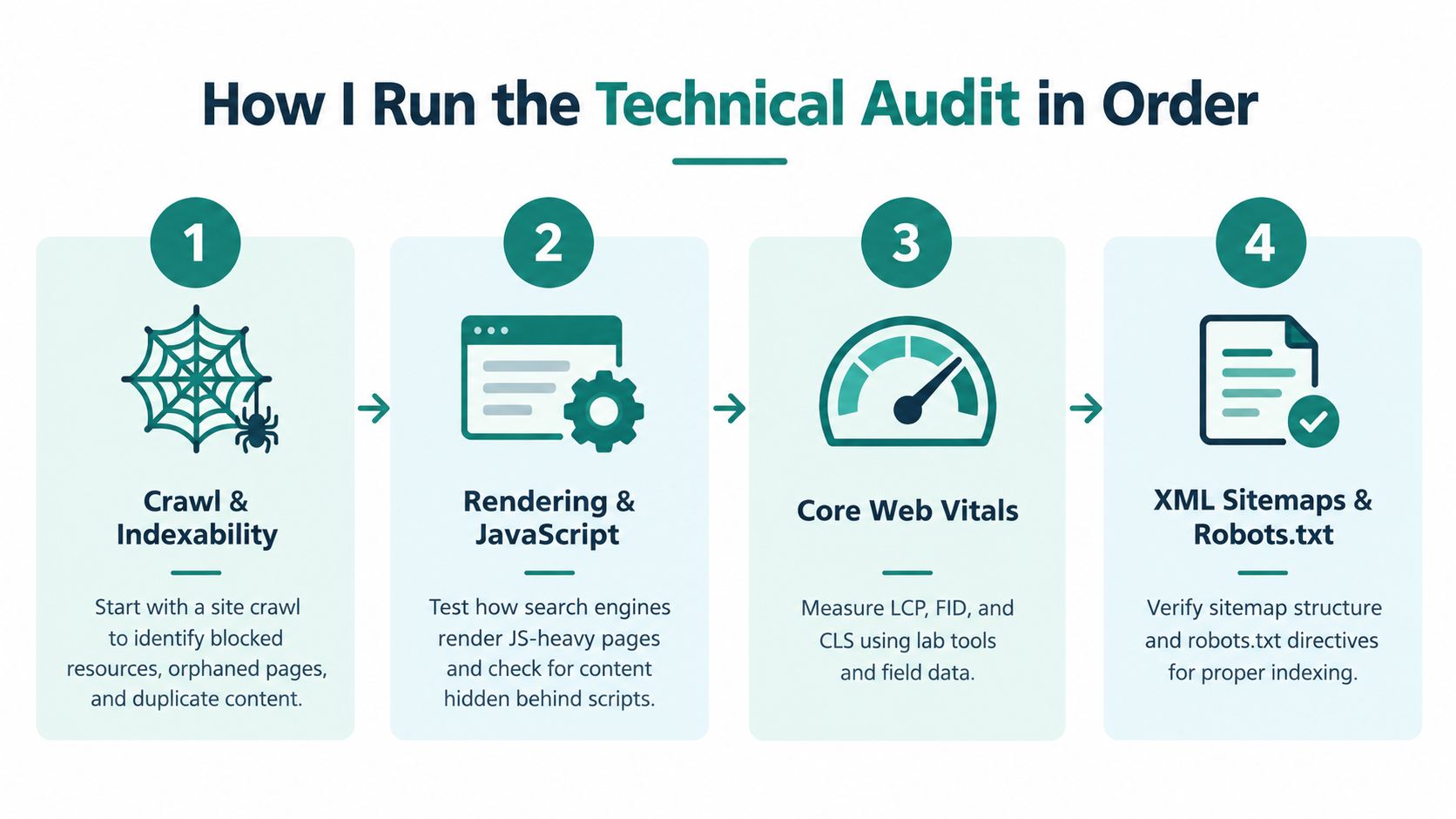
How I Run the Technical Audit in Order
I start with crawlability and indexability because performance work on a page Google can't access is wasted effort. The sequence matters: each stage gives context to the next one.
Crawl and indexability come first
Run a crawl with JavaScript rendering available, then compare the results with Search Console. Look for blocked resources, accidental noindex directives, status-code errors, orphaned pages, duplicate URLs and pages that return content to users but not to search engines.
I check whether important pages are linked internally, whether they appear in the index and whether Google has selected the intended canonical. A crawler may report a page as accessible while Search Console shows it isn't indexed, so both views are necessary.
The common failure is treating every warning equally. A missing image alt attribute and a service template carrying a noindex directive don't belong in the same priority group.
Rendering and JavaScript need a separate test
JavaScript-heavy London sites often look complete in a browser but expose little useful HTML to a crawler or search engine. Compare the raw HTML with the rendered DOM, inspect key content and test navigation, links, headings, metadata and structured data after rendering.
This matters for React, Next.js and heavily personalised ecommerce experiences. If product names, prices, service descriptions or internal links appear only after a script runs, rendering failure can affect both discovery and interpretation.
Use URL Inspection in Search Console alongside the crawler. Test important templates, not just the homepage. A single successful rendering test doesn't prove that every route, component or mobile state works correctly.
Core Web Vitals require lab and field evidence
PageSpeed Insights gives useful lab diagnostics, while Chrome User Experience Report field data shows how real users experience eligible pages. UK audit guidance recommends using both because JavaScript and third-party scripts can create different results in controlled and real-world conditions.
Google defines a good page experience at the 75th percentile when LCP is 2.5 seconds or less, INP is 200 milliseconds or less, and CLS is 0.1 or less. These thresholds come from Google's Core Web Vitals documentation, and they're not average scores.
Search Console groups URLs when it has enough data, then assigns the group status according to the worst-performing metric. Its published bands classify LCP as good at 2.5 seconds or under, needs improvement between 2.5 and 4 seconds, and poor above 4 seconds. For INP, the bands are good at 200 milliseconds or under, needs improvement to 500 milliseconds, and poor above 500 milliseconds. CLS is good at 0.1 or under, needs improvement to 0.25, and poor above 0.25, as set out in Search Console's Core Web Vitals report guidance.
Don't optimise a single score in isolation. Identify the element affecting LCP, the interaction delaying INP or the component moving the layout, then give the developer a specific cause and test method.
Validate directives and URL signals
Next I review XML sitemaps, robots directives, canonicals and redirects. Sitemaps should contain the URLs the business wants indexed, not old redirects, duplicate parameter versions or pages marked noindex. Robots.txt should control crawling carefully, rather than being used to hide pages that should be removed from the index.
Canonical tags should point consistently to the preferred version. Redirects should lead directly to the final destination, especially after a replatform or domain change. Chains and loops waste crawl resources and create poor user journeys.
Schema comes after the core access signals. I test whether the markup reflects the visible page and whether it uses an appropriate type for the content. Structured data can't repair inaccessible content or make an irrelevant page useful.
Finally, inspect internal linking. Important commercial pages need contextual links from relevant content, clear navigation and sensible anchor text. Orphaned pages, excessive links in templates and weak links to location pages are common findings.
The final technical report should state the affected URL pattern, the cause, the recommended change, the implementation owner and the validation step. That format is more useful than a long export of warnings.
London and Local Checks That Change Your Priorities
A technically clean website can still lose London enquiries if its local signals and conversion paths are weak. I treat local SEO as a commercial layer, not a directory submission exercise.
UK search behaviour makes proximity especially important. A 2026 UK summary reports that 93% of online experiences begin with a search engine, 76% of people searching for something nearby visit a business within a day, and 68% of online searches use a “near me” modifier with a location, according to the UK SEO Industry Report 2026. The same source reports that 70% of clicks go to organic results over paid ads, while 89% of consumers read reviews before visiting a local business.
Those figures change the audit order for a London firm. A page that ranks reasonably but hides the phone number on mobile may deserve attention before a minor metadata inconsistency. A multi-location business may need clearer distinctions between branches, coverage areas, opening times, transport information, accessibility and the services available at each location.

Compare local competitors, not abstract scores
I benchmark the site against a small peer set in the same London market. The comparison includes page structure, service coverage, local landing pages, Google Business Profile completeness, review activity, category choices, mobile usability and the route from search result to enquiry.
That comparison reveals practical gaps. One competitor may have weaker technical performance but clearer service-area pages. Another may have fewer pages but stronger reviews and a simpler booking path. The right response isn't to copy everything. It's to identify which missing signal affects the customer's decision.
Local pages also need editorial judgement. Creating a page for every borough without distinct service information usually produces repetition. A useful page explains who the business serves, where it works, what the customer can expect and how to take the next step.
Measure friction beyond rankings
I check mobile menus, click-to-call links, forms, map details, trust content, review visibility and whether the landing page matches the wording of the search. Analytics and enquiry tracking should show whether organic visitors complete the intended action.
A ranking report alone can't tell you why enquiries fail. An SEO audit should connect impressions and clicks to the path that follows, then place conversion friction beside technical and local findings in the same priority model.
The relevant benchmark is not a universal score. It's the distance between the business's current experience and the clearest local competitor journey.
From Findings to Fixes Deliverables Timeline and White Label Options
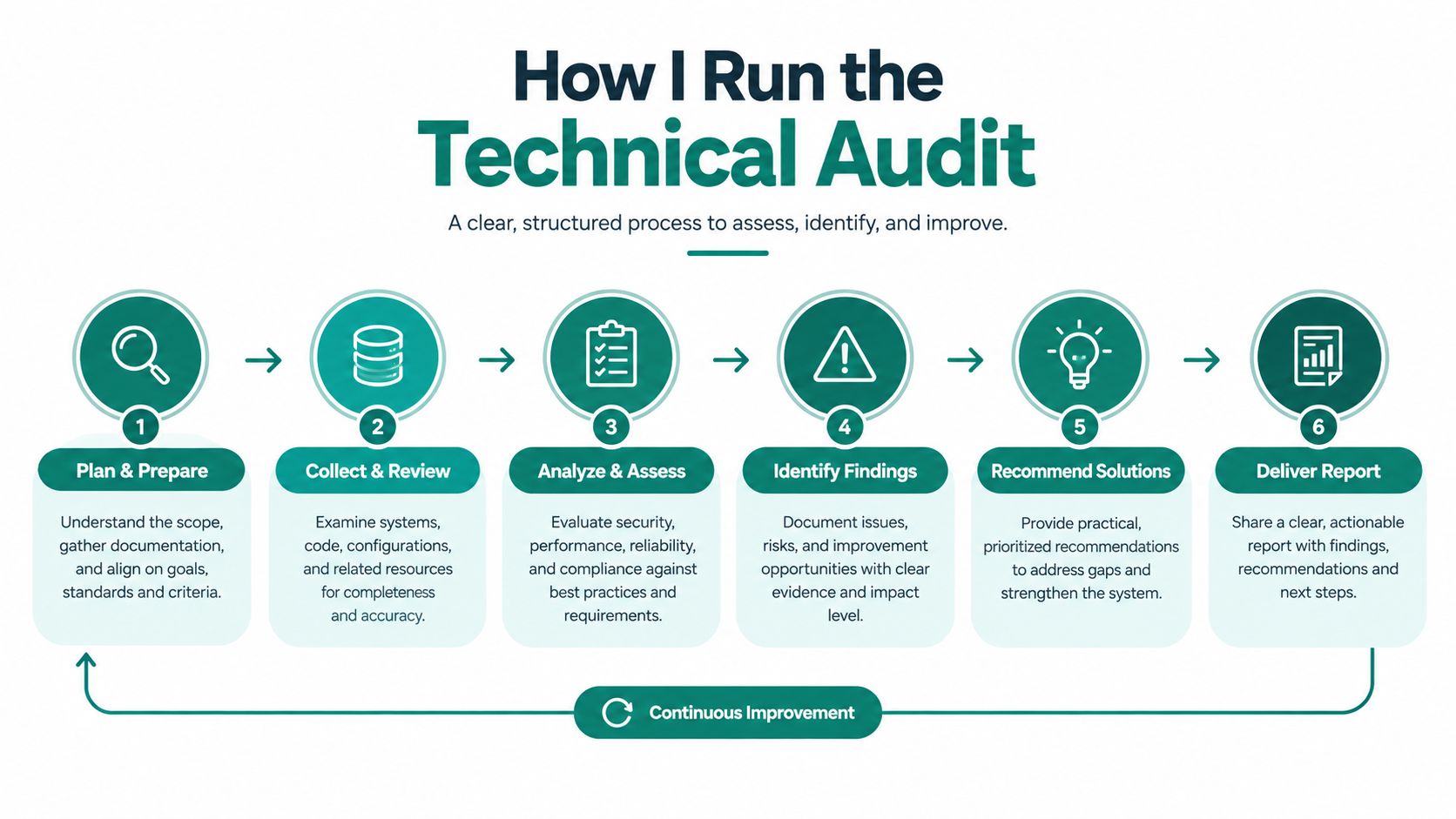
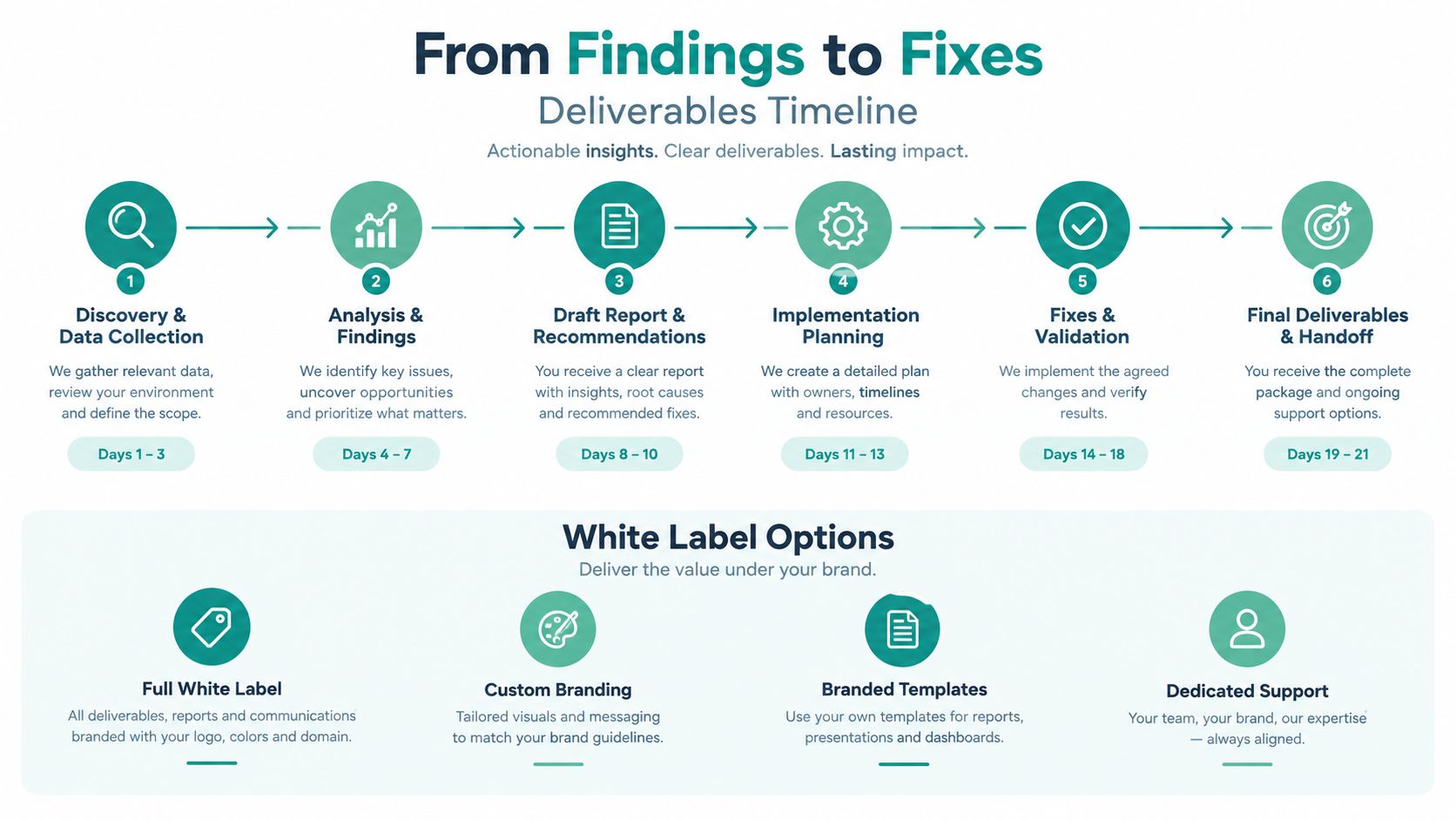
An audit becomes useful when the recipient can act without translating it. My preferred deliverable starts with a short executive summary, followed by a remediation backlog, evidence, implementation specifications and a measurement plan.
Each finding should answer five questions:
- What is wrong: State the issue without jargon.
- Where is it happening: Name the URL, template or pattern.
- Why it matters: Connect it to crawling, visibility, usability or enquiries.
- What should change: Describe the implementation rather than merely naming the problem.
- How will we validate it: Define the re-crawl, Search Console check, field data review or conversion test.
For a technical audit covering up to roughly 1,000 URLs, UK guidance commonly describes the work as a two-to-five specialist-day engagement, as noted in UK SEO audit guidance. That range reflects the difference between a crawler export and a manual review involving rendering, Search Console diagnosis and developer-ready specifications.
The delivery timeline depends on scope, access and site complexity. I collect data first, investigate the highest-value patterns, review local and commercial journeys, write the backlog, discuss implementation constraints and then produce the final handoff. A large ecommerce or multi-location site needs more validation than a compact brochure site, even when the crawl contains fewer obvious errors.
Choose the delivery route that matches the work
| Delivery Route | Best For | What You Get | Timeline |
|---|---|---|---|
| DIY review | Small teams with technical access and time to investigate | Tool exports, internal notes and self-managed fixes | Depends on internal capacity |
| Direct commission | Businesses needing an independent technical and commercial view | Prioritised audit, specifications, walkthrough and measurement plan | Agreed around scope and access |
| White-label delivery | Agencies without senior SEO or development capacity | Confidential audit under the agency's brand, with NDA and no direct client contact | Agreed with the agency |
The priority order should usually put crawlability and indexation before content polishing, then canonical and redirect problems, then rendering and performance issues, followed by schema, internal linking, local pages and broader content opportunities. That isn't a rigid rule. If mobile visitors can't complete a high-value enquiry form, the commercial impact may justify moving that fix forward.
Agencies can use a white-label SEO and web development service when they need delivery under their own brand. The practical requirements are clear communication, NDA protection, no direct contact with the agency's client and files that can be handed over without rewriting.
Acting on Your Audit and What to Do Next
The week after an audit should be operational, not theoretical. Agree the priority backlog with the people responsible for development, content, local listings and commercial reporting. Then ship the highest-impact technical fixes first, re-crawl the affected templates and use Search Console to validate indexing and URL signals.
After the foundation is stable, improve the pages that match valuable London intent. Strengthen internal links, refine service and location content, remove conversion friction and track enquiries rather than rankings alone. Field Core Web Vitals should be reviewed as real-user data develops, while form submissions, calls and bookings show whether the work is helping the business.
Near-perfect technical hygiene is achievable. A 2024 council website benchmark reported SEO compliance as high as 99.38% and desktop performance scores as high as 93, demonstrating what disciplined implementation can produce, as summarised by UK SEO audit benchmarking. The document itself doesn't create that result. The quality of the fixes, the testing and the follow-through do.
Re-audit after a major migration, template release or structural change, and revisit the priority backlog when performance or enquiry patterns shift. For a direct project or a confidential agency handoff, Sibley Digital can provide the audit, implementation support and plain-English reporting needed to move from evidence to action.
If your London site needs a technical, local and commercial review, visit Sibley Digital to discuss an SEO audit built around prioritised fixes and measurable outcomes. Agencies can also request confidential white-label delivery under their own brand, with clear handoff documents and no direct contact with end clients.