
A white label SEO audit isn't mainly a report. It's a controlled delivery system that lets an agency sell senior technical, on-page, content and performance analysis without putting another name in front of the client. That distinction matters because only 43% of websites pass all Core Web Vitals on mobile, while 42% of mobile sites achieve good Time to First Byte under 800 milliseconds, according to the UK benchmark cited by White Hat SEO's website audit guidance.
I'm Will, a London-based SEO and website consultant. I deliver audits to agencies that keep the client relationship, presentation and commercial ownership. The useful question isn't whether an audit can be branded. It's whether the partner can work invisibly, produce evidence that survives scrutiny, and turn findings into a backlog someone can implement.
Table of Contents
- What a White Label SEO Audit Actually Is
- Why Agencies Outsource Audits in the First Place
- The Four Pillars a White Label Audit Covers
- Technical SEO as a Worked Example
- Typical Deliverables and How They Are Packaged
- How the Engagement Runs Day to Day
- Common Misconceptions Worth Clearing Up
- What to Look for When You Brief One
What a White Label SEO Audit Actually Is
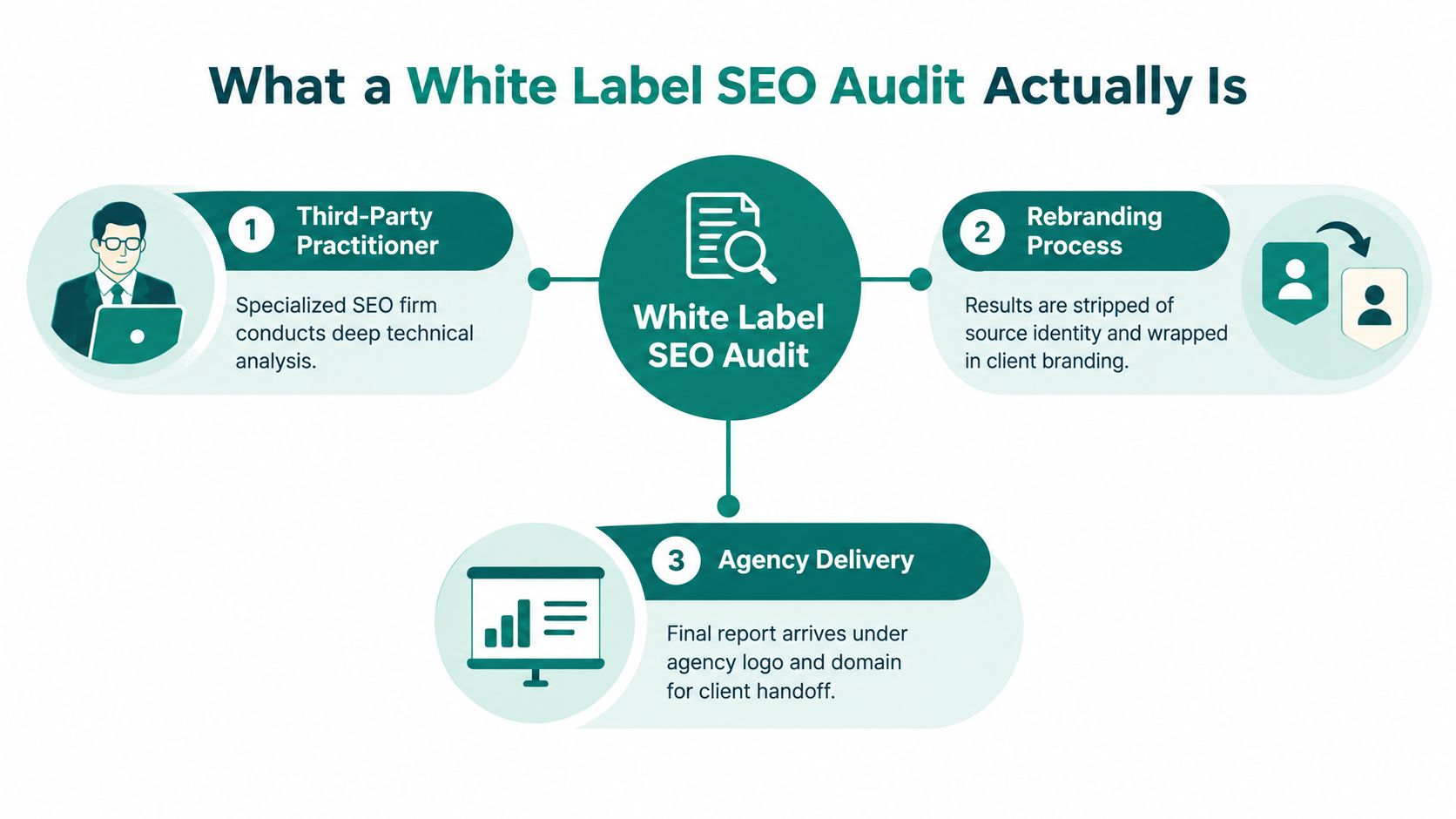
A white label SEO audit is a website analysis produced by a third-party practitioner, then rebranded and delivered under an agency's own logo, colour palette and domain. The agency presents the work as part of its service, while the specialist behind it remains invisible by design.
The operational model is straightforward:
- The agency supplies the brief, access and commercial context.
- The white-label practitioner crawls, analyses and reviews the site.
- The agency receives editable, branded or brand-ready deliverables for client presentation.
The audit work usually happens off-agency, either with a senior consultant working alone or within a small specialist team. The important point is that the output isn't a screenshot dump from an SEO platform. It should contain interpretation, prioritisation and recommendations that fit the client's CMS, templates, commercial goals and development capacity.
The boundaries are part of the product
An NDA should cover the work both ways. The agency protects client data and commercial information, while the practitioner agrees not to disclose the relationship, reuse confidential material or claim public credit without permission.
The agency keeps the client relationship. The white-label partner has no contact with the end client, no visibility of client email, and no presence on client calls unless the agency explicitly changes that arrangement. There should be no accidental CC, provider watermark or unexplained external calendar invitation.
Editable source files give the agency control. A report may arrive as a document, presentation or spreadsheet that can be rebranded, annotated or divided into client-facing slides. That separation is what makes the model work. It's also the boundary many providers describe loosely and enforce poorly.
Practical rule: if the partner needs to speak directly to the client to explain routine findings, the arrangement isn't fully white label.
The partner is invisible by design, not hidden as a temporary courtesy. The agency owns the narrative, decides what the client sees and remains accountable for the recommendations it presents.
Why Agencies Outsource Audits in the First Place
Most agencies don't outsource audits because they lack SEO knowledge. They outsource because their delivery model wasn't built to absorb specialist diagnostic work at short notice.
Capacity comes first
Account teams are staffed to deliver retainers, manage approvals and keep existing work moving. A new prospect can suddenly require a deep technical review involving a crawl, template analysis, performance checks, content assessment and competitor research. That work can occupy a senior practitioner for days, displacing work that's already sold.
A white-label partner gives the agency extra capacity without forcing the account team to choose between a pitch deadline and a live client programme. The agency still owns the scope and recommendations, but the analysis doesn't have to compete with every other deadline.
Senior judgement is difficult to hire
A credible audit requires more than knowing where buttons sit in Screaming Frog. Someone needs to distinguish an indexation problem from a reporting artefact, understand how JavaScript affects rendering, read log data in context and connect technical issues with traffic, revenue and implementation risk.
That senior expertise is expensive to keep idle. Hiring a full-time specialist may make sense for a large SEO department, but it can be difficult to justify when audit demand fluctuates. Specialist support lets an agency buy the capability when the workflow needs it.
Revenue also shapes the decision. Agencies may sell an audit-led engagement for £8,000 to £15,000, while paying a white-label partner a fixed fee for the diagnostic work. Those figures are commercial examples of the model, not a universal price benchmark. The agency keeps the client relationship and margin, without taking on a permanent salary, unused capacity or a lengthy recruitment process.
Speed and risk affect pitches
A partner with established templates, tooling and QA processes can turn a brief around in days. That matters when an agency needs credible evidence for a proposal rather than a generic list of possible SEO services.
There's a risk-control benefit too. A weak internal audit can lose a pitch and damage confidence in the agency's wider SEO offer. Outsourcing the diagnostic layer to an experienced practitioner reduces the chance that an account manager or overstretched junior produces work that looks busy but fails to explain what should happen next.
For agencies assessing how to add specialist capacity, LatHire is a useful resource for comparing flexible access to marketing and technical talent. It doesn't remove the need for a clear white-label boundary, but it helps frame the wider choice between hiring, contracting and partnering.
None of these pressures indicates a failing agency. They're structural consequences of selling flexible services while trying to keep fixed overheads under control.
The Four Pillars a White Label Audit Covers
A proper audit should make the scope visible before the work starts. I normally separate the analysis into four pillars, then bring every finding into one prioritised backlog. That prevents a performance issue appearing in one document, an internal-linking issue in another and no clear order of work between them.
| Pillar | What it covers | Common tools | Artefact produced |
|---|---|---|---|
| Technical | Crawlability, indexation, architecture, XML sitemaps, robots.txt, hreflang, schema, JavaScript rendering and log file analysis | Screaming Frog, Sitebulb, OnCrawl | Prioritised fix list mapped to URLs or templates |
| On-page | Title tags, meta descriptions, heading hierarchy, internal linking and canonicalisation | Screaming Frog exports, Ahrefs, Semrush Site Audit | Spreadsheet of issues grouped by template |
| Content and links | Thin content, cannibalisation, topical gaps, backlink profile toxicity and link velocity | Ahrefs, Semrush, Google Search Console | Content brief backlog and link audit summary |
| Performance | Core Web Vitals, mobile usability and page weight | PageSpeed Insights, Chrome UX Report, Lighthouse | Performance issue list with likely front-end causes |
Technical analysis needs context
The technical pillar should answer whether search engines can discover, crawl, render and index the right pages. That means checking more than status codes. Architecture, faceted navigation, sitemap accuracy, canonical signals and JavaScript behaviour often interact, so isolated issue counts can mislead.
A blocked URL may be harmless if it's an intentional account page. A canonical tag may be correct on one template and damaging on another. The useful artefact maps the finding to affected URL groups and states the consequence.
On-page work should be template-led
On-page analysis becomes more useful when it groups problems by page type. Product, category, service, article and location templates often need different title logic, internal-linking rules and content requirements.
A sheet that marks every duplicate title as a separate emergency creates noise. A template-level recommendation can give the developer or content team one fix that resolves a repeated pattern across the site.
Content and links require judgement
Ahrefs, Semrush and Search Console can expose gaps, overlap and suspicious patterns, but the tools don't decide whether two pages should merge, be retargeted or remain separate. That requires an understanding of intent, audience and the client's commercial priorities.
The output should therefore include a content brief backlog, not merely a keyword export. Link findings also need interpretation. A referring-domain count by itself doesn't explain relevance, risk, lost opportunities or the next sensible action.
Performance belongs in the same backlog
Performance findings shouldn't sit in a decorative appendix. They need owners and implementation notes, such as front-end development, content operations or platform configuration.
The four pillars are distinct for analysis, but they shouldn't produce four disconnected reports. A strong white-label audit gives the agency one queue, with severity, dependency, owner and retest criteria.
Technical SEO as a Worked Example
Core Web Vitals show the difference between an automated signal and a useful audit recommendation. Google's page experience signals made performance, responsiveness and visual stability a foundational part of technical SEO work from 2021, and UK agencies now need to treat those checks as operational benchmarks rather than soft guidelines, as outlined by Visionary Marketing's technical SEO guidance.
The benchmark is assessed at the 75th percentile of real-user data:
| Metric | Threshold at p75 | Common front-end cause | Typical fix |
|---|---|---|---|
| LCP | Under 2.5 seconds | Render-blocking JavaScript, unoptimised hero images or slow TTFB | Compress and prioritise the main image, defer non-critical scripts and improve server response |
| INP | Under 200 milliseconds | Long main-thread tasks or event-handler bloat | Reduce JavaScript work, split tasks and simplify interaction handlers |
| CLS | Under 0.1 | Late-loading web fonts or dynamically injected content slots | Reserve dimensions, stabilise font loading and define media space |
A useful audit states that LCP failed without delay. It identifies the affected template, shows whether the issue appears in field data or lab testing, and names the likely implementation class. Search Console's Core Web Vitals report groups similar URLs by Poor, Need improvement and Good status, and by LCP, INP and CLS, which makes it useful for finding template patterns rather than chasing one anomalous page, as explained in Digital Scientists' SEO audit guidance.
From signal to ticket
A fix-ready ticket might read:
- Severity: High
- Affected template: Product detail pages
- Finding: The primary image is the largest content element and loads after several blocking scripts
- Suggested owner: Front-end developer
- Recommended action: Serve an appropriately sized image, preload the critical asset and defer non-essential scripts
- Retest: Recheck the affected URL group in field and lab data
That format gives the agency something it can discuss with a developer and place into a roadmap. A Lighthouse score alone doesn't provide that clarity.
The same logic applies to CLS and INP. If layout shifts come from injected promotional modules, the ticket should identify the component and reserve its space. If interaction delay comes from a heavy menu script, the recommendation should point to the script or event path rather than vaguely asking for a faster site.
For a broader explanation of the diagnostic boundary, this guide to what a technical SEO audit covers is a useful reference. The practical standard is simple: every important signal should lead to a decision, an owner and a way to verify the result.
Typical Deliverables and How They Are Packaged
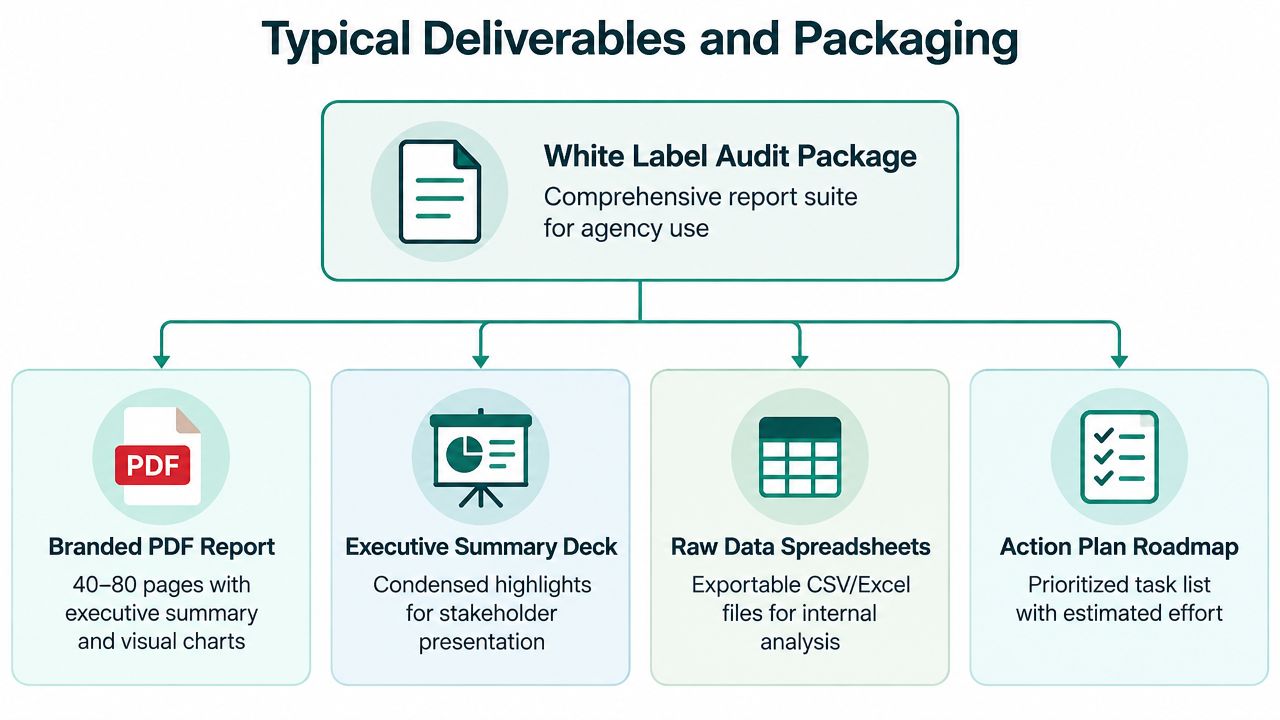
The usual package contains more than a PDF. The PDF is the client-facing explanation, while the backlog, source data and measurement setup make the work usable after the presentation.
The report
A branded PDF report is often 40 to 80 pages, with an executive summary, findings by pillar and prioritised recommendations. That page range is a packaging convention, not a quality measure. A shorter report can be stronger if it removes repeated screenshots and explains the decisions clearly.
The cover should use the agency's logo, typography and colours. The body copy should sound like the agency, not like a third-party vendor. There shouldn't be partner watermarks, unexplained tool branding or references that force the account team to rewrite every page.
The working files
The implementation layer usually includes:
- Prioritised backlog: Google Sheets, Notion, ClickUp or Jira, with issue, URL or template, severity, owner suggestion, effort and expected impact.
- Source exports: Screaming Frog, Ahrefs, Sitebulb and other relevant exports, retained so the agency can inspect the evidence.
- Dashboard: Looker Studio or DashThis connected to Google Search Console and GA4, where access and tracking are available.
- Handover material: A walkthrough deck, presentation notes and a recording that lets the account team explain the findings without the partner joining the client meeting.
The backlog is the part that turns the audit into delivery. A PDF can explain that a site has unstable layout or duplicate canonicals. A ticket tells someone which template to change and what evidence will confirm the fix.
The reporting cadence also needs agreement. Some audits end with a single handover. Others include a re-audit or quarterly tracking cycle, with the agency retaining responsibility for deciding which recommendations become active work.
For a practical example of how reports can be structured, this SEO audit report template guide is useful when comparing formats. The question isn't whether a supplier has a polished template. It's whether the files can move directly into the agency's presentation and delivery workflow.
How the Engagement Runs Day to Day
The engagement should feel predictable from the first conversation. I start with a scoping call that establishes the objective, site size, CMS, competitors, access requirements and deadline. A pitch audit, migration review and retainer diagnostic may use similar tools, but they don't need the same depth or output.
Commercially, the arrangement is usually either a fixed project fee or a monthly retainer with an agreed audit allocation. The scope should state what happens when the site is larger than expected, when access is delayed or when the agency adds competitor and content work after the original brief.
The NDA is signed before client data is shared. The white-labelling rules should be written down at the same point:
- No client contact: The partner doesn't email, call or attend meetings with the end client.
- No partner branding: Deliverables contain the agency's identity, with no provider credit or watermark.
- No public disclosure: The partner doesn't use the agency or end client as a case study without written permission.
- Single communication route: Requests stay in an agreed Slack channel, project board, Loom thread or email chain.
A typical workflow has an initial scope, data collection and crawling, analysis, rebranding and QA, then secure delivery. The exact calendar varies with site complexity and access, so a promised turnaround should be tied to inputs rather than presented as an unconditional guarantee.
Handover normally ends with a walkthrough deck and recorded Loom. The account team gets enough context to present the recommendations, answer predictable questions and explain which items need developer, content or commercial decisions. A white-label SEO dashboard guide can help agencies think through the measurement layer alongside the audit itself.
The no-client-contact rule protects both sides. The agency avoids confusing ownership, while the partner avoids making commitments outside the agreed scope. If the client needs specialist input, the agency can request it deliberately and decide whether the partner should appear under a different commercial arrangement.
Common Misconceptions Worth Clearing Up
White label doesn't mean low quality. It describes ownership and presentation, not the standard of analysis. A senior practitioner can produce the work, while the agency packages it under its own brand.
It isn't a junior task. Reading a crawl, interpreting logs, tracing rendering issues and prioritising fixes against business data requires judgement. A junior can support data collection, but a credible audit needs experienced review.
It doesn't replace in-house SEO. The partner supplies the diagnostic layer. The agency's strategist or account manager still decides how the findings fit the retainer, which work gets approved and how progress is explained.
Reports don't have to sit unused. The failure mode is a raw PDF on a shared drive. A ticketed backlog with owners, dependencies and retest criteria gives the agency a route from evidence to implementation.
A partner shouldn't reach out to the end client without authorization. The NDA and clean-team rules exist to prevent that. Unapproved contact creates confusion over accountability and can end the engagement.
A white-label audit is not a way to outsource responsibility. It's a way to outsource specialist analysis while keeping responsibility clear.
UK agencies should also distinguish an SEO audit from an accessibility audit. For public sector websites, the required standard is WCAG 2.2 at level AA, with automated tools, manual review and assistive-technology testing, according to GOV.UK's accessibility audit guidance. Those obligations need their own scope and specialist method rather than being implied by an SEO report.
What to Look for When You Brief One
Ask for a sample report under a generic brand and inspect the findings, not the page count. The sample should show whether the practitioner explains causes, affected templates, implementation owners and likely effort.
Confirm that the deliverable includes a prioritised backlog. A flat issue list isn't enough. Ask how the partner handles severity, dependencies, estimated impact and retesting.
The commercial and confidentiality questions are just as important:
- NDA: Is it signed before access is provided?
- Contact rules: Is no client contact explicit?
- Tools: Which platforms are included, and which are licensed per audit?
- Editing: Can the agency change the report without rebuilding it?
- Handover: Is there a strategist walkthrough, presentation support and a defined Q&A window?
I'd also ask for a written summary of decisions made after the report. That record prevents the same unresolved question from resurfacing during implementation.
For agencies looking for a UK-based practitioner-led option, Sibley Digital provides manual SEO audits covering technical, content, intent and competition factors, followed by a prioritised roadmap and walkthrough. The relevant test is the same as with any provider: whether the work fits the agency's process and produces actions the client can understand.
Sibley Digital offers confidential white-label SEO audits and web development for agencies, with NDAs, branded deliverables and no direct contact with end clients. Visit Sibley Digital to discuss a fixed-scope audit, technical review or implementation roadmap that can sit behind the agency's own client delivery.