
Most advice about choosing a B2B SEO marketing agency starts with the wrong premise. B2B SEO isn't consumer SEO with a longer sales cycle. The essential work is identifying the audience signals that matter, mapping different forms of intent to the right pages, and fixing the technical foundations that let those pages perform. An agency that ignores any of those three areas can produce polished content and attractive reports without moving pipeline.
For context, UK search is already a major commercial channel. The UK digital advertising market reached £42.6 billion in 2024, with search accounting for £16.9 billion and growing 12.8% year on year, according to UK digital advertising market data. By the first quarter of 2025, UK advertising spend had reached £10.6 billion, while search was up 12.3% year on year from the same source. The opportunity is substantial, but only when SEO is connected to the way B2B buyers research, compare and approve suppliers.
Table of Contents
- What a B2B SEO Marketing Agency Actually Does
- How B2B SEO Differs From B2C Search
- Core Services in a B2B SEO Programme
- White-Label and Senior Consultant Delivery Options
- How to Select the Right B2B SEO Partner
- Starting a B2B SEO Engagement That Moves Revenue
What a B2B SEO Marketing Agency Actually Does
The common misbuy is hiring a general SEO agency and assuming it will automatically understand B2B. It may know how to fix title tags, publish articles and build links. That doesn't mean it can distinguish a search from a researcher, a technical evaluator, a procurement stakeholder and a decision-maker.
A B2B SEO marketing agency starts with a narrower question: which searches come from the people a company can serve, and what must those people see before they become a qualified opportunity? The answer shapes research, information architecture, page briefs, internal links, calls to action and measurement.
The agency's job is to turn search demand into a usable commercial system. That normally means:
- Audience research: Identify industries, roles, problems, terminology and buying triggers rather than relying on broad demographic labels.
- Intent mapping: Separate educational, solution, comparison, vendor and implementation searches so one page isn't forced to answer incompatible questions.
- Site architecture: Place service, industry, solution and evidence pages where search engines and buyers can find them.
- Search-ready delivery: Improve crawlability, rendering, page speed, structured data, copy, links and conversion paths.
- Commercial measurement: Connect organic activity to meaningful enquiries, opportunities and revenue wherever the CRM and analytics setup allows it.

What generic SEO often misses
Generic programmes commonly begin with a keyword list and a publishing quota. That approach can work for straightforward consumer searches, but it often produces B2B content that attracts people who will never buy, service pages that lack proof, or blog posts that compete with the pages designed to convert.
B2B buyers also search in language that may not match a company's internal positioning. Engineers, finance teams and commercial leaders can describe the same problem differently. A strong agency interviews subject-matter experts, reviews sales conversations and studies existing customers before finalising the content plan.
Technical work matters just as much. A beautiful service page can't perform reliably if the CMS creates duplicate URLs, important pages sit deep in the architecture, JavaScript prevents meaningful rendering, or a release breaks canonicals. The agency should be able to explain the defect, its business effect and the implementation route in plain English.
For a useful overview of the operational detail involved, B2B SEO best practices from Machine Marketing offers a helpful reference point. When comparing suppliers, ask whether their proposal includes these decisions or just promises more traffic and more content.
Practical rule: If a provider can't explain which audience, intent and page change should influence pipeline, you're probably buying activity rather than B2B SEO.
How B2B SEO Differs From B2C Search
B2C search often has a relatively direct relationship between query and transaction. Someone searches for a product, compares price or availability, and may buy during the same session. B2B search usually has more layers. Different people research the category, define requirements, assess risk, validate suppliers and approve spend.
That changes the job of every page. A B2B article may need to create confidence with a technical evaluator, while a solution page must help a commercial buyer understand fit, proof and next steps. Ranking one page for a broad term isn't enough if the site doesn't support the rest of the decision.
UK data reinforces the commercial importance of getting this structure right. Organic search drives 44.6% of B2B revenue, while SEO leads close at 14.6%, compared with 1.7% for outbound prospecting, according to UK B2B SEO strategy research. Those figures don't mean every company will achieve the same result. They do show why an agency should measure search against revenue contribution, not traffic alone.
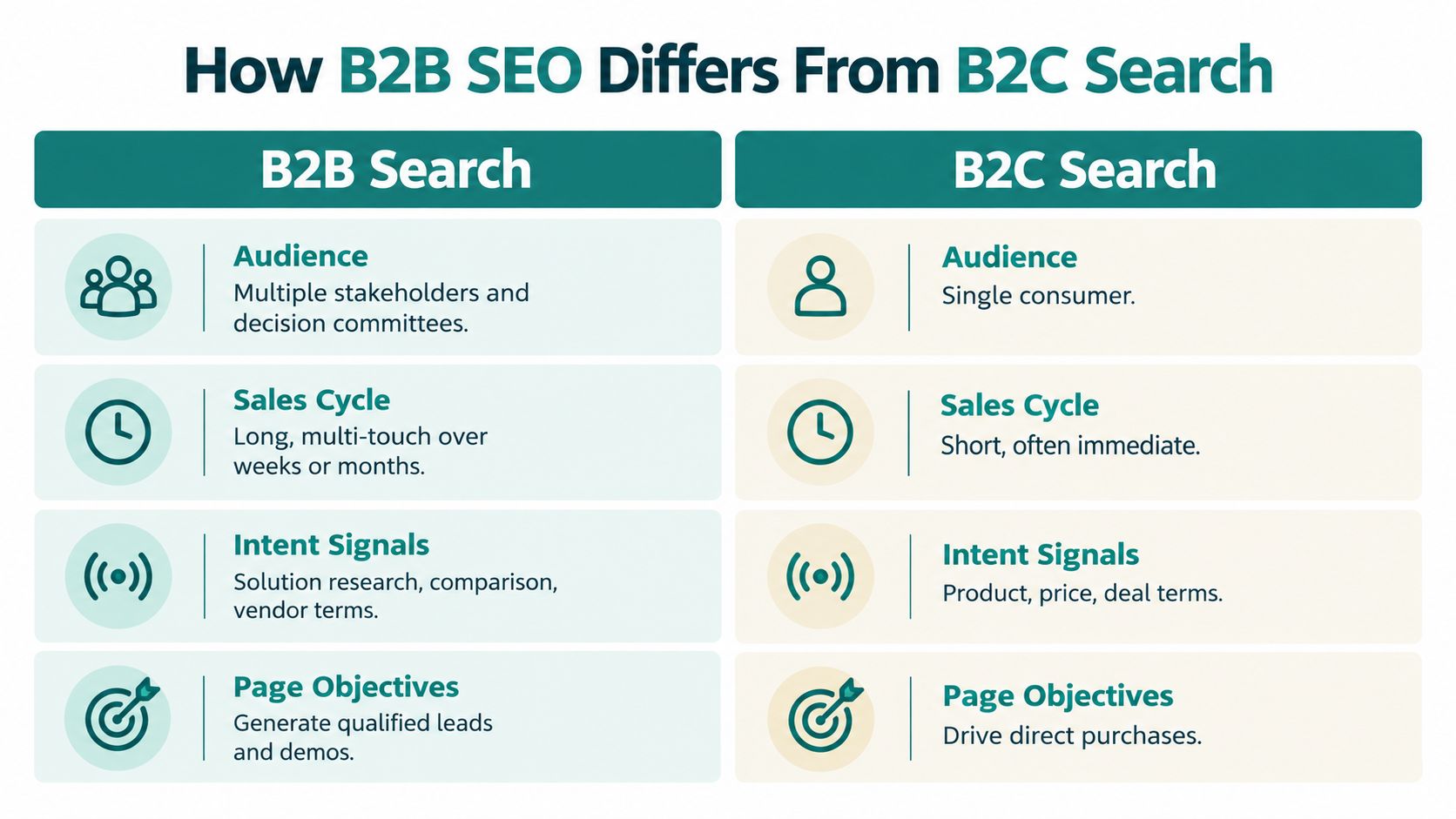
The structural differences
| Area | B2B search | B2C search |
|---|---|---|
| Audience | Multiple stakeholders and decision groups | Often one consumer |
| Sales path | Research, comparison, validation and approval | Frequently a shorter purchase path |
| Intent | Solutions, vendors, implementation and risk | Products, prices, offers and availability |
| Page objective | Qualified leads, demos and assisted pipeline | Direct purchase or immediate action |
The table isn't a rigid rule. A low-cost B2B product may have a short journey, while an expensive consumer purchase may involve extensive research. The point is that page objectives should follow the actual buying process, not the category label.
For instance, a B2B service page might need sector-specific outcomes, delivery detail, security information, implementation guidance and a credible route to speak with someone. A consumer category page may prioritise filters, stock, price and transactional clarity. Applying the second model to the first often creates pages that rank for generic interest but fail to answer buying objections.
The technical priorities differ too. B2B sites often have complex service taxonomies, resource libraries, regional pages, integrations and stakeholder content. The agency must control duplication, canonical signals, internal linking and indexation so commercial pages aren't buried beneath low-value templates.
I also expect the agency to understand the relationship between SEO and sales enablement. Search content should give sales teams useful answers to recurring questions, not sit apart as a publishing exercise. A practical guide to an outbound sales system for B2B teams can help frame that wider relationship between demand creation and direct outreach.
Core Services in a B2B SEO Programme
B2B SEO services aren't separate products that can be selected without regard to one another. Technical SEO determines whether search engines can access and interpret the site. On-page SEO makes individual pages relevant to a defined intent. Content creates useful coverage across the buying journey. Measurement shows whether the work supports commercial outcomes.
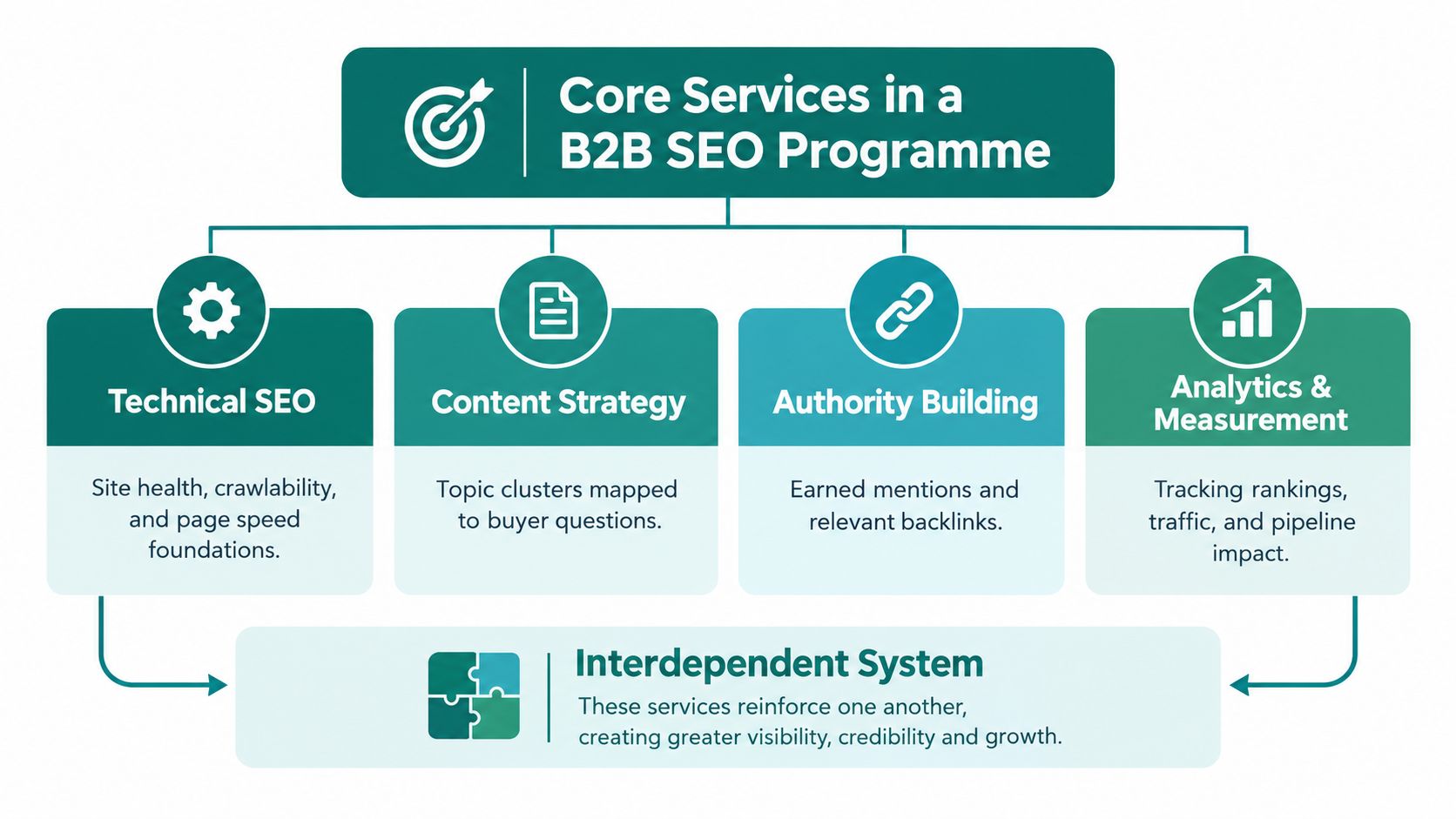
Technical SEO comes first
A technical audit should examine crawlability, indexation, rendering, redirects, canonicals, templates, structured data, mobile experience, page speed and release controls. Tools such as Screaming Frog, Sitebulb, Google Search Console, PageSpeed Insights and server log analysis each reveal different problems.
The UK benchmark is sobering. The median SME site scores 58 out of 100 for technical readiness. Only 46% pass mobile Core Web Vitals, 38% use valid structured data, 27% deliberately manage internal linking, 14% have performed log-file analysis and 9% run technical regression checks after release, according to UK technical SEO benchmark data.
Those gaps matter because content can't compensate for blocked crawling, poor rendering or an index full of competing duplicates. The agency should prioritise fixes by commercial importance, not produce a long list that developers can't use.
On-page SEO gives each page a job
On-page SEO isn't just inserting a keyword. It means matching the page to one primary intent, using language the audience recognises, clarifying the entity or service, structuring headings, improving titles and descriptions, and making the next step obvious.
A service page should explain who the service is for, what changes in practice, what evidence supports the claim and what happens after contact. An educational page should answer the research question without disguising a sales pitch as advice. Internal links then connect supporting questions to commercial destinations.
Content strategy decides what deserves creation, consolidation or refresh. I use this guide to creating a content strategy as a practical reminder that content planning should start with audience demand and business goals, not a calendar of arbitrary topics.
Measurement must reflect the funnel
A useful report shows what changed, why it changed and what happened afterwards. It should distinguish visibility from qualified visits, enquiries, marketing-qualified leads, sales opportunities and closed revenue where the data allows.
That might require Google Analytics 4, Google Search Console, a CRM such as HubSpot or Salesforce, call tracking and a consistent source and campaign structure. Rankings still help diagnose performance, but they aren't the commercial result. A page can rank well for an irrelevant query and create no useful opportunity.
Authority building fits into the same system. Relevant industry mentions, expert contributions, digital PR and earned links can strengthen important pages, but indiscriminate link volume is a poor substitute for relevance. The agency should explain why a particular source, relationship or asset supports the audience and page being prioritised.
White-Label and Senior Consultant Delivery Options
Digital agencies often need SEO or web capacity without handing their client relationship to another supplier. A white-label B2B SEO partner works behind the agency's brand, follows its communication process and keeps the end client relationship confidential. The practical controls matter more than the label.
A sound arrangement defines who attends meetings, who owns approvals, where documents live, how feedback is handled and what happens when delivery changes. NDAs, no public credit and strict non-contact with end clients are common safeguards, but they should be written into the working agreement rather than assumed.
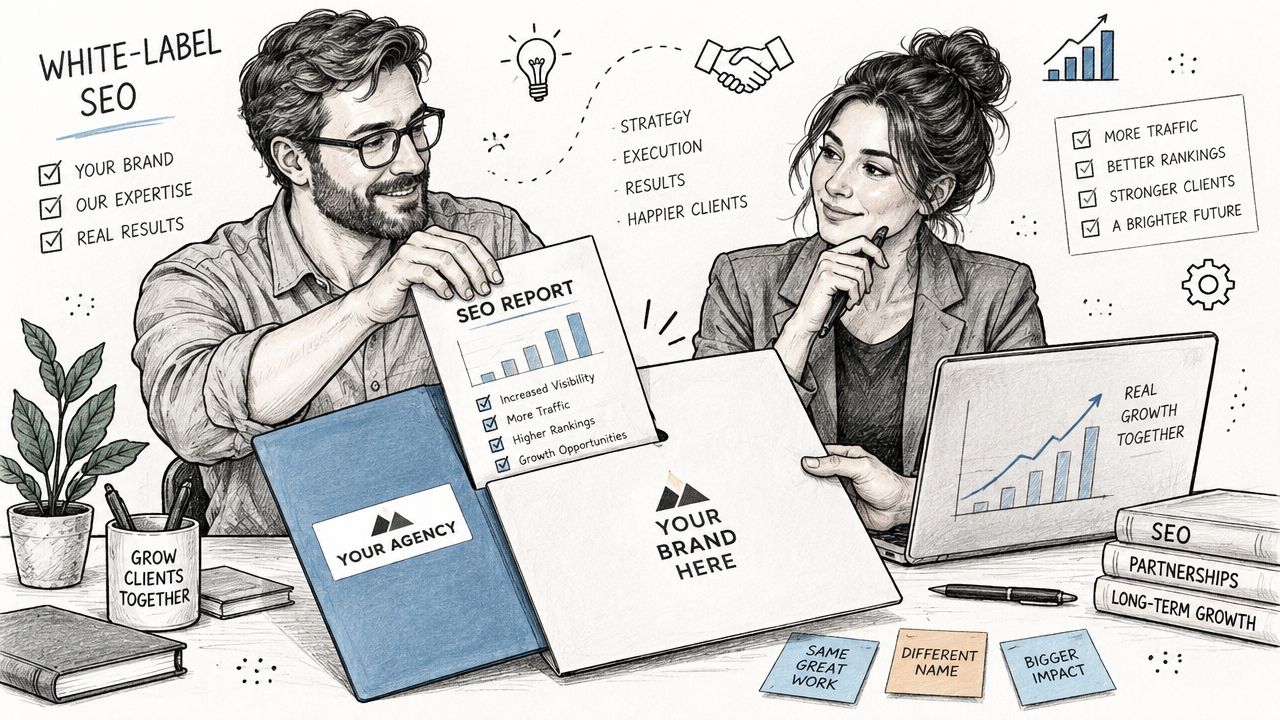
White-label delivery suits capacity gaps
White-label works well when an agency already owns strategy, brand and account management but needs a senior specialist to perform the work. It can support technical audits, content plans, migrations, WordPress or Webflow builds, Shopify projects and ongoing implementation without forcing the agency to recruit every capability internally.
The trade-off is coordination. Every additional handover can slow decisions or distort recommendations. The partner needs clear access, a defined brief and a reliable escalation route. The agency also remains accountable to its client, so it must understand enough of the work to present it accurately.
A useful white-label SEO model for agencies should cover confidentiality, deliverables, review stages and client boundaries, rather than just promising invisible fulfilment.
Direct senior delivery removes an account layer
Direct delivery suits a company that wants to speak with the person making the recommendations. The benefit is context. A senior consultant can move from an audit to a prioritised roadmap, explain trade-offs directly to developers and help stakeholders decide what not to do.
That model has limits. One practitioner won't provide the same production capacity as a large team, and availability can become a constraint when a project needs several specialist disciplines at once. It can still be the better choice when the challenge is strategic ambiguity, a complex rebuild or a stalled programme rather than content volume.
| Delivery model | Best fit | Main trade-off |
|---|---|---|
| White-label partner | Agencies needing confidential specialist capacity | More coordination between supplier and account team |
| Senior consultant | Businesses needing direct expertise and accountability | Less suited to high-volume production |
| Larger agency team | Programmes requiring multiple delivery disciplines | Potential distance between senior strategy and implementation |
Ask who will do the work, who will join client calls, how changes are approved and who owns the final recommendation. Those answers tell you more than a service list.
How to Select the Right B2B SEO Partner
The UK consultancy market is crowded and mature. It reached an estimated £24.6 billion in revenue for 2025-26, with 35,088 businesses operating in the category, according to the UK SEO industry market report. Buyers therefore need to assess the operating model, not just compare impressive terminology.
Start with evidence of thinking. Ask for a relevant example of how the supplier handled audience research, intent mapping, technical constraints and conversion design. You don't need a case study with identical numbers or sector wording. You do need to see how the provider made decisions and measured whether those decisions worked.
Questions that expose delivery quality
A strong discovery conversation should answer practical questions:
- Who is the audience? Can the agency describe the roles, problems and language of the people likely to influence a deal?
- Which pages matter commercially? Does it identify service, solution, sector, comparison and evidence pages, or does it lead with a generic keyword list?
- What happens technically? Will it inspect crawl paths, rendering, indexation, templates, structured data and release processes?
- Who implements recommendations? A strategy that sits in a development backlog won't improve the site. Establish whether the agency supplies implementation, works with your team or only sends tickets.
- How is content made credible? Ask who interviews subject-matter experts, checks claims and edits the final piece.
- What gets reported? Expect a connection between organic discovery, qualified actions and CRM stages, not a dashboard dominated by impressions.
I also look for a clear point of view on AI search visibility. UK B2B revenue leaders already show demand here: 63% have budget for activities aimed at improving AI search visibility, while 29% plan to allocate budget in the next twelve months, according to UK B2B buyer research on AI search. The useful question isn't whether a supplier uses the latest acronym. Ask how it improves entity clarity, answer structure, source quality and the likelihood that a brand is understood and cited accurately.
Red flags in proposals
Be cautious when a proposal promises a fixed ranking outcome, treats every page as a blog post or offers a standard publishing quota without examining the site. Vague reporting is another warning sign. If the agency can't explain what counts as a qualified outcome, it may be optimising for activity that looks good in monthly slides.
I wouldn't reject a supplier because it lacks a glossy portfolio. I would reject one that can't show the work behind its recommendations, name the tools it uses or explain how it handles a failed hypothesis. You can use a wider resource to compare B2B marketing partners, then test each shortlist against your own audience, systems and commercial process.
For a more focused evaluation, this guide to choosing an SEO consultant provides useful questions around experience, communication and accountability. The right partner should make the buying decision clearer, not bury it under jargon.
Starting a B2B SEO Engagement That Moves Revenue
Begin with a defined commercial problem. It might be weak visibility for a high-value service, a website rebuild that risks losing search equity, poor conversion from organic visits or a content library that attracts the wrong audience.
Request an initial audit of the technical foundation, key page types, search intent, internal linking, existing content and measurement. Ask the agency to separate urgent defects from strategic opportunities, then show which recommendations affect revenue pages or conversion paths.
You should also request:
- A prioritised roadmap: Each action should have an owner, rationale, dependency and expected business relevance.
- A measurement plan: Define the organic actions and CRM stages that will be tracked, not just rankings and sessions.
- A content model: Show which audience questions map to which pages, and where expert input is required.
- An implementation route: Confirm who will change templates, publish content, configure tracking and test releases.
- A review cadence: Agree how progress, obstacles and new evidence will shape the next set of decisions.
Don't start by commissioning a large batch of articles. Start by finding the audience signals, intent gaps and technical constraints that determine whether those articles can contribute to pipeline. That sequence produces a more defensible programme and gives sales, marketing and development teams a shared view of what SEO is meant to achieve.
Sibley Digital provides practitioner-led B2B SEO, technical SEO and search-ready website development, including confidential white-label delivery for agencies. Visit Sibley Digital to discuss an engagement built around audience intent, sound implementation and measurable commercial outcomes.